
In India, the Central Board of Secondary
Education (CBSE) is one of the most preferred options, not only for its wide
reach but also for its structured approach to academic and holistic
development. Whether you’re a student, parent, or educator, this guide explains
everything you need to know about the CBSE curriculum.
What Is the CBSE Curriculum and Who Governs It?
The CBSE Curriculum is a structured learning framework created to provide uniform education across India while promoting skill development and exam readiness. It is governed by the Central Board of Secondary Education, a national-level board under the Ministry of Education. Established in 1962, CBSE was created to ensure a unified, standardized, and quality education system across India.
CBSE aims to promote innovation in
teaching-learning methodologies, improve student skillsets, and prepare
learners for higher education and competitive exams, while also fostering
values and life skills.
How Is the CBSE Curriculum Structured Across Grade Levels?
The curriculum is carefully tiered to match
students’ stages of growth and development:
●
Primary
Stage (Grades I–V): Emphasis on foundational learning in languages,
mathematics, environmental science, and creativity.
●
Middle
Stage (Grades VI–VIII): Broader subjects like social science, science,
mathematics, Hindi, English, and introduction to skill-based learning.
●
Secondary
Stage (Grades IX–X): Core focus on mathematics, science, social science,
English, and additional languages. Students prepare for the first major
milestone, the Class 10 Board Exam.
●
Senior
Secondary Stage (Grades XI–XII): Students select from three primary streams:
➢
Science
(Physics, Chemistry, Biology, Mathematics, Computer Science)
➢
Commerce
(Accountancy, Business Studies, Economics, Mathematics, Entrepreneurship)
➢
Humanities/Arts
(History, Political Science, Sociology, Psychology, Literature, and Fine Arts).
What Are the Key Features of the CBSE Curriculum?
The CBSE curriculum blends academics with
values and skills, staying relevant to both global trends and Indian needs.
●
NCERT Textbooks as the backbone of teaching.
●
Focus on holistic development through sports, co-curriculars, and life
skills.
●
CCE and modern assessment reforms to evaluate skills beyond rote learning.
●
Alignment with NEP 2020 for competency-based and multidisciplinary
education.
What Subjects Are Offered Under the CBSE Curriculum?
CBSE provides a wide range of core, elective,
and modern skill-based subjects, giving flexibility to students.
●
Core Subjects: English, Hindi, Science, Mathematics, Social Science.
●
Electives: Psychology, Computer Science, Fine Arts, Music, Physical
Education.
●
Skill/Vocational Subjects: Coding, Artificial Intelligence,
Entrepreneurship, Financial Literacy, Tourism, Healthcare.
How Is Teaching Conducted in CBSE Schools?
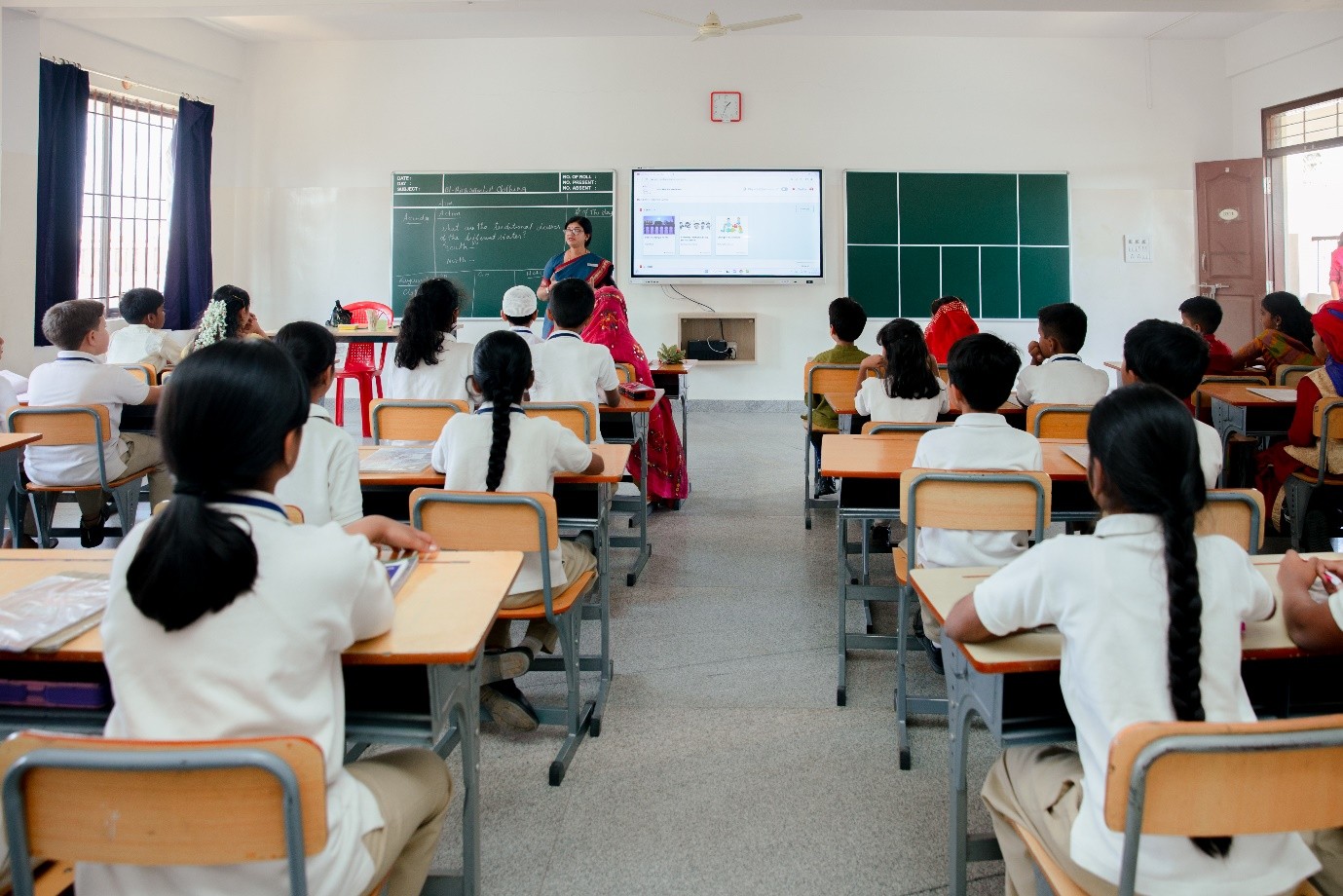
Teaching in CBSE schools combines traditional
learning with new-age methodologies and technology.
●
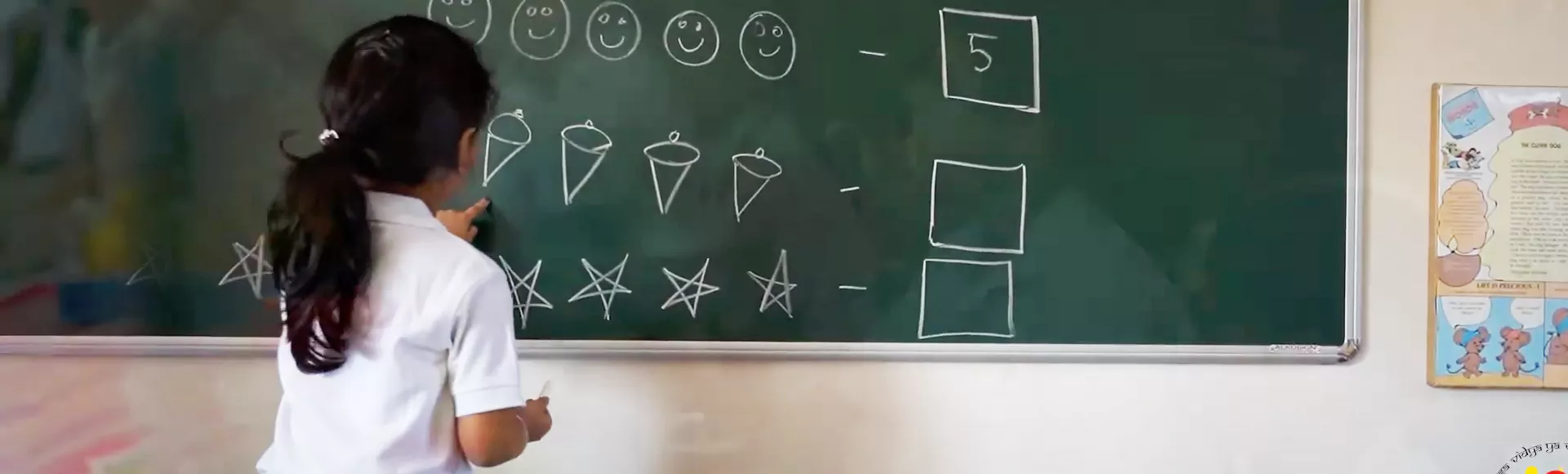
Pedagogy: Inquiry-based, activity-driven classrooms.
●
Technology Integration: Smart boards, e-learning, and interactive
tools.
●
Experiential Learning: Projects, field visits, labs, and life-skill
programs.
How Does the CBSE Assessment and Exam System Work?
CBSE assessments are structured to balance
internal learning evaluation with high-stakes national exams.
●
Internal Assessment: Periodic tests, projects, practical work.
●
Board Exams: Objective + long-answer format for Class 10 & 12.
●
Grading System: 9-point grading scale ensures fairness.
How is CBSE Different from Other Boards?
CBSE stands apart for its national reach and
exam-friendly framework when compared with ICSE, State Boards, or international
systems.
●
CBSE vs ICSE: Concept-based, exam-oriented vs. detail-heavy
curriculum.
●
CBSE vs State Board: Nationwide uniformity vs local flexibility.
●
CBSE vs IB/IGCSE: Structured, exam-driven vs inquiry-led, international.
●
Competitive Exams: CBSE is ideal due to NCERT alignment with JEE, NEET,
UPSC.
Are the Advantages of Studying in the CBSE Curriculum?
Parents often prefer CBSE because of its
portability, exam-readiness, and balanced approach.
●
Consistent
standardization across India &
abroad.
●
Strong STEM orientation.
●
Easy transferability between schools.
●
Natural career and competitive exam alignment.
What Are the Latest Changes in the CBSE Curriculum?
With NEP 2020, CBSE has initiated major
reforms to prepare students for a dynamic future.
●
Introduction
of Coding, Artificial Intelligence, and
Financial Literacy.
●
More
focus on competency-based and
experiential learning.
●
Growing
emphasis on multidisciplinary approaches.
Is the CBSE Curriculum Right for You or Your Child?
The CBSE curriculum is more than just a syllabus; It’s a balanced framework of academics, values, and skills. With its learner-centered pedagogy, alignment to NEP 2020, and focus on holistic growth, CBSE remains one of the most trusted boards in India. Whether you’re preparing for competitive exams or seeking global opportunities, CBSE provides a well-structured, future-ready education.
If you’re looking for a CBSE-affiliated school in Bangalore that emphasizes not only academics but also character, creativity, and life skills, Vidyanjali Academy for Learning could be the right choice for your child. Known for its nurturing environment, experienced teachers, and activity-driven learning, Vidyanjali blends the strength of CBSE academics with a holistic approach to education.
1. Is CBSE good for competitive exams?
Yes. Since CBSE is closely linked with NCERT
textbooks, it provides the strongest foundation for exams like JEE, NEET, and UPSC.
2. Is CBSE harder than ICSE?
Not exactly. ICSE can be broader and more
detailed. CBSE focuses on core concepts and application-based learning.
3. Is the CBSE curriculum recognized globally?
Yes, many international universities accept
CBSE transcripts, and CBSE schools operate in 25+ foreign countries.
4. Is CBSE suitable for international students?
Yes. With English as a primary medium and
global recognition, CBSE is suitable for students relocating from abroad.
5. Are CBSE schools only in India?
No. Several CBSE-affiliated schools function
in the Middle East, Southeast Asia,
Africa, and Europe, catering to expatriate families.