

When you
visit a well-designed primary school classroom today, you may not see rows of
desks reciting from blackboards. Instead, you may find corners for quiet
reading, digital tablets alongside books, and students working in small groups
or even by themselves.
What has
changed is not just the furniture or the gadgets but the very heart of how we
help children learn. In the primary years, teaching methodologies do more than
convey information; they shape how children learn, think, question, and apply
knowledge.
Good
methodologies aim to reach beyond memorisation, nurturing young minds to
develop curiosity, creativity, and a love for learning. In this blog, we look
at the most common teaching methodologies used in schools like Vidyanjali
today, why educators adopt them, and how they benefit children.
What Are the Most Common Teaching Methodologies Used in Primary Schools?
Primary school isn’t just about ABCs and 123s; it’s
where little minds start to wonder and figure out how the world works. Teachers
today use all kinds of creative tricks, from hands-on projects to playful
learning, to make sure every child finds their spark.
Let’s take a closer look at the most common teaching
methods that shape those curious young minds:
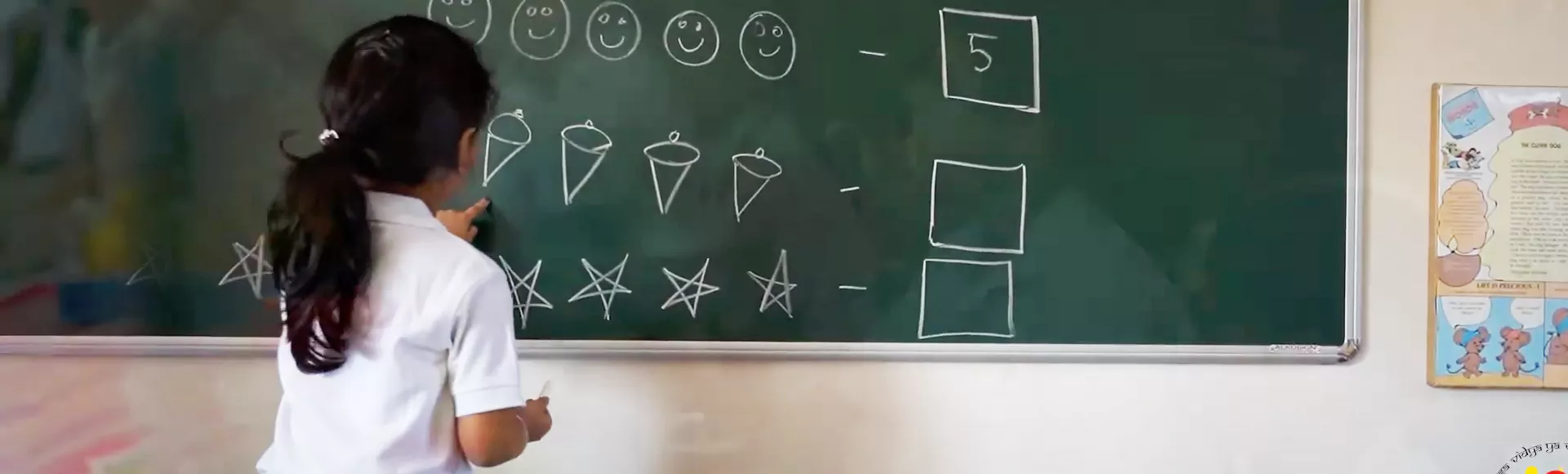
1. Traditional Lecture-Based Method
In the
traditional model, the teacher delivers lessons often with books or a
blackboard, and children listen, copy notes, and learn facts. Here are some of
its strengths and limitations:
|
Strengths |
Limitations |
|
An efficient way to cover large
amounts of curriculum content. |
Tends to encourage rote
memorisation rather than deep understanding. |
|
Familiar and structured, with
clear expectations. |
Does not cater well to children
who learn better by doing, seeing, or exploring. |
|
Easy to assess through standard
tests. |
Limited scope for creativity,
collaboration, and critical thinking. |
Think of
this approach as the dependable workhorse of teaching, especially useful when
precision, repetition, and clarity are needed. It shines in situations like:
●
Foundational literacy
drills: Sounding out letters, practising phonics,
and recognising sight words.
●
Numeracy drills: Times tables, simple calculations, basic arithmetic fluency.
●
Early grammar and vocabulary
lessons: Where rules and repetition matter.
●
Large-group instruction: When everyone needs to be on the same page, literally.
●
Launching a new topic: Setting the foundation before shifting to experiments, discussions,
or hands-on tasks.
Used
wisely, the lecture method can be a strong backbone, and when blended with more
active, playful, or inquiry-driven approaches, it becomes a powerful part of a
balanced teaching toolkit.
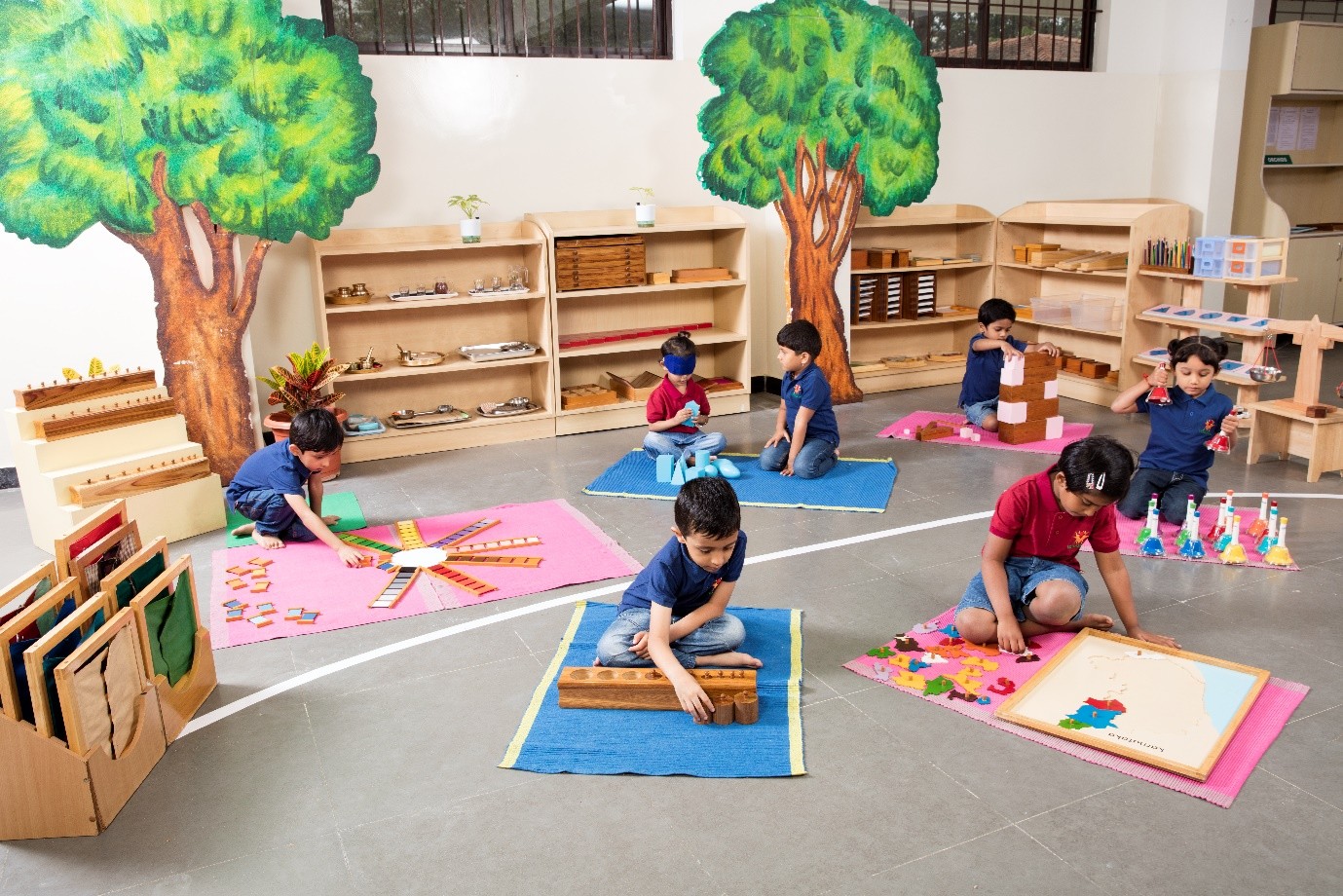
2. Montessori Method
Originated
by Maria Montessori, this approach emphasises self-directed learning, sensory
exploration, and structured freedom. In a Montessori-inspired environment:
●
Children are free to choose
their own activities from shelves that are within their reach. These shelves
are stocked with hands-on materials (often made of wood or designed to
stimulate the senses), so kids can pick what interests them and work at their own
pace.
●
Learning emphasises hands-on,
concrete experience first, especially for early years, then gradually builds
toward abstract thinking.
●
The teacher acts as a guide,
observing when to intervene, encouraging independence, respect, order, and
intrinsic motivation.
This
method nurtures concentration, independence, and a deep understanding of
foundational concepts, whether in language, maths, or practical life skills. It
is especially effective in early primary settings where children benefit from
movement, touch, and self-paced progress.
3. Project-Based Learning (PBL)
Under the
National Education Policy 2020 (NEP 2020) and in many progressive schools, PBL
is gaining ground. Students engage in extended, real-world projects
(individually or in teams) to solve problems or create a meaningful product.
Here is
why it matters:
●
Deep learning: Children understand concepts in context, see their relevance, and
retain them better.
●
21st-century skills: Collaboration, communication, critical thinking, and creativity are
all strengthened through PBL.
●
Motivation and ownership: When children see real-world relevance, learning becomes more
engaging and meaningful.
Many
schools combine PBL with inquiry-based or experiential strategies, encouraging
students to research, experiment, and present findings.
4. Inquiry-Based Learning
Here,
learning begins with questions, not answers. Instead of simply teaching facts
first, the teacher poses open-ended problems or prompts inquiry. Students then
investigate, discuss, reflect, and arrive at an understanding through their own
reasoning.
For
example, instead of telling students how plants grow, a teacher might ask,
“What do you think will happen if a plant doesn’t get sunlight?” Students can
then set up mini experiments, observe results, and share their findings to
understand photosynthesis and plant growth. By the end, they don’t just know
what happens; they understand why.
Here’s
why it works:
●
Encourages curiosity, critical
thinking, and independent problem-solving.
●
Helps children learn how to
learn, not just what to learn.
●
Builds confidence as students
discover answers themselves rather than relying solely on the teacher.
Inquiry-based
learning often dovetails with project-based or experiential methods, especially
in subjects like science, social studies, and language.
5. Experiential Learning
Often
described as learning by doing, this methodology emphasises concrete
experiences (field trips, labs, role plays, environmental work, and
experiments), followed by reflection and conceptual understanding. This aligns
with a widely recognised model called Kolb's Learning Cycle.
Here are
its benefits:
●
Makes learning tangible and
relevant. Children remember not just facts but experiences.
●
Caters to different learning
styles, such as kinesthetic, visual, and auditory.
●
Builds real-world skills like
observation, experimentation, and problem-solving.
Many
schools today, especially those guided by NEP 2020, use experiential learning
across subjects, including science, environmental studies, arts, and physical
education.
6. Differentiated Instruction
Every
child learns differently. Differentiated instruction adapts what is taught and
how it is taught based on each child’s abilities, interests, and pace.
This
methodology supports inclusion, ensuring that advanced learners are challenged,
struggling learners are supported, and every child can progress meaningfully.
Whether a child needs extra time, alternate explanations, or enrichment tasks,
differentiated instruction ensures no one is left behind.
7. Collaborative Learning
Learning
is not always a solitary act but often happens in groups: classmates discussing
a topic, working together on projects, peer teaching, or group investigations.
Collaborative learning builds:
●
Communication and social skills
●
Teamwork and shared
responsibility
●
Empathy and co-learning
Many
modern classrooms intentionally design group activities or peer-based tasks,
especially in project-based and inquiry-based models, to harness the power of
collective thinking.
8. Play-Based Learning
Especially
in the early primary years (Grades 1–3), play remains a powerful medium for
learning. Through games, role play, storytelling, arts, music, and
dramatisation, children acquire social skills, language, creativity, emotional
regulation, and foundational academic concepts.
NEP 2020
recognises play-based and activity-based learning as essential, particularly
for younger learners, offering a gentle, age-appropriate bridge from early
childhood to formal schooling.
Which Teaching Methodology is Best for Primary Students?
There is
no one best method. Children, even in the same class, differ widely in their
temperaments, interests, pace, and strengths. What works brilliantly for one
may feel limiting for another.
Factors
such as age, learning style, and subject should guide which methodology to use.
The best schools adopt a mix of methodologies: traditional when needed,
exploratory when possible, hands-on when relevant, collaborative or individual
as per the child.
Likewise,
at Vidyanjali, we believe in a holistic, integrated approach, combining methods
based on a child’s age, temperament, and readiness. Rather than enforcing a
one-size-fits-all approach, we tailor our teaching philosophy to suit each
classroom and each student, ultimately creating an environment where every
child can flourish.
What Does the National Education Policy (NEP 2020) Say About
Teaching Methods?
NEP 2020
marks a paradigm shift in Indian school education. It calls for:
● Reduced reliance on rote memorisation and high-pressure exams.
● Use of digital content, e-learning, and blended pedagogy.
● Focus on competency-based learning, moving towards foundational
literacy and numeracy, critical thinking, creativity, and ethical and social
capacities.
● Emphasis on play-based, experiential, integrated, arts- and
activity-based pedagogy, especially in early years (ages 3–8) and early
primary.
Why Vidyanjali Academy is a Pioneer in Progressive Teaching Methodologies?
With
roots going back to 1992, Vidyanjali Academy has built decades of experience
around a simple but powerful vision: to create globally competent and socially
responsible citizens. At its heart, Vidyanjali blends traditional values
(respect, responsibility, perseverance, fairness, caring) with modern pedagogy
that meets the needs of today’s children.
Beyond
textbook teaching:
●
Classrooms are equipped with
smart boards, projectors, and audio-visual systems to support varied learning
styles.
●
Science labs and innovation
centres encourage hands-on experiments and projects, allowing children to apply
concepts instead of passively memorising them.
●
Children have opportunities in
arts, music, dance, sports, yoga, and various clubs (chess, IT, science),
helping them discover passions.
If you
are looking for a school that treats your child as a unique individual, not a
batch number, and helps them grow academically into kind, thoughtful human
beings, Vidyanjali is worth exploring. To learn more about the values that make
Vidyanjali Academy a nurturing home for young minds, contact
us.