

At
Vidyanjali Academy, we believe that social studies is not just another subject;
it is a way of understanding the world and our place in it. From the everyday
life of our neighbours next door to the lives of people across oceans in
distant continents, social studies helps children make sense of their
surroundings and grow into thoughtful citizens.
For many
parents, social studies can feel like a broad, unfamiliar term. Is it history,
geography, or civics? The simple answer is that it is all of these and more.
Below, we walk you through what social studies means, why it matters, and how
we bring it alive in our primary classrooms at Vidyanjali.
What is Social Studies in Primary School?
In
primary school, social studies, often called SST (Social Studies/Social
Science), is an integrated subject that helps children understand how people
live, work, govern, and interact with their environment. Rather than focusing
solely on dates and facts, the curriculum emphasises the development of
awareness, curiosity, and social understanding.
Typically,
it encompasses:
●
History: Stories of people, communities, past events, and heritage.
●
Geography: Learning about the physical world, maps, landforms, the
environment, and how people interact with it.
●
Civics/Political Science: Understanding basic governance, communities, cultures, and social
structures.
●
Economics: At an introductory level, children may learn about family, trade,
markets, and work, helping them understand how society organises resources.
Some
curricula also weave in environmental studies, especially in the early years,
combining natural and social aspects to help children relate to their immediate
surroundings.
Why is Social Studies Important in Primary Education?
Primary
years are when children begin to look beyond themselves and their immediate
family. Social studies plays a vital role in gently guiding this expanding
awareness. Here are some core objectives:
●
Expand the child’s mental
horizon gradually from their home and immediate surroundings to the wider
country and eventually the world.
●
Develop awareness of diversity
(social, cultural, linguistic, and economic) and instil respect for people from
different backgrounds.
●
Foster a sense of social
responsibility, cooperation, and equality, preparing children to relate to
others respectfully, regardless of class, caste, creed, or religion.
●
Build civic competence and an
understanding of community, governance, and rights, helping shape conscientious
future citizens.
●
Encourage appreciation for
human labour, resources, the environment, and the interdependence inherent in
society.
How does social studies help in character and civic development?
Social
studies helps children build values: respect for diversity, empathy for
different communities, understanding fairness and justice, and awareness of
human rights.
Through
stories of communities, past events, geography, and economics, children learn
that society is not uniform; people come from varied backgrounds, cultures, and
traditions, yet coexist. This exposure fosters tolerance, empathy, cultural
sensitivity, and a sense of belonging and responsibility.
By
introducing basic civic concepts early (community life, governance, resource
use), social studies helps children grow into informed citizens, aware of their
role in society.
How do Teachers Make Social Studies Interesting for Primary Students?
Engagement
in social studies comes from relevance. When lessons are connected to the
child’s own life (home, school, friends, and surroundings), interest naturally
follows.
Teaching
social studies must therefore move beyond textbooks. Many schools emphasise
student-centred pedagogies such as:
●
Project-based learning /
activity-based learning: Children work on projects,
role-play community scenarios, build models, create maps, or collaborate on
group assignments, making learning hands-on and social.
●
Collaborative and
cooperative learning: Students learn together,
share ideas, and understand multiple viewpoints, which helps build social
skills and respect for diversity.
●
Storytelling, narration, and
real-life examples: Teachers often blend visuals,
maps, charts, timelines, and real stories with interactive methods. Field
visits, community interactions, and environment walks, anything that connects
classroom lessons to a child’s real world, help anchor learning in tangible
experience.
What Are the Best Teaching Methods for Social Studies in Primary School?
Strong
primary programmes combine multiple teaching methods to suit different learning
styles and developmental stages.
One of
the most effective teaching methods, Inquiry-Based Learning (IBL), places
students at the centre. Instead of the teacher merely delivering facts,
children ask questions: “Who helps keep our city clean?”, “Why do people live
near rivers?”, or “What happens when resources are limited?”
They are
then encouraged to investigate, discuss, analyse sources, and draw conclusions;
this method fosters critical thinking, research skills, and ownership of
learning. Students learn to think like historians, geographers, and economists
rather than just memorise names or dates.
Another
one of the most effective methods, integrated learning (or multidisciplinary
approach), involves viewing social studies not as separate silos but as parts
of one living social world. Through integrated learning, a lesson might
include:
●
A history story about a local
festival
●
Geography about the climate or
environment of that region
●
Culture and social norms
surrounding the festival
●
Basic economics (trade,
agriculture, or livelihood) related to that area
What Skills Do Students Develop Through Social Studies?
Social
studies is naturally suited to building critical thinking. When children
explore history, geography, or civics, they are encouraged to ask questions
such as: Why did events unfold that way? How do different communities view the
same issue differently? This process of inquiry helps them:
●
Analyse relationships: They learn that nothing in history, whether events, societies, or
people, exists in isolation.
●
Use evidence and evaluate
sources: When studying past events or social
issues, children examine different sources (maps, narratives, stories,
accounts) to understand multiple perspectives.
●
Ask open-ended, thoughtful
questions: This prompts them to reflect, reason,
and form their own opinions rather than rely on memorisation.
When
students engage in group discussions, collaborative projects, role-plays, or
simulations (for example, imagining the life of people in past eras or
rebuilding a historical event), they develop communication skills.
Social
studies also helps children appreciate diversity and different perspectives. As
they learn about various cultures, traditions, and social systems, they begin
to respect differences, building tolerance, compassion, and social sensitivity.
What Are the Challenges in Teaching Social Studies at the Primary Level?
Even with
the best intentions and methods, teaching social studies at the primary level
has its challenges:
● Abstractness of concepts: Many
historical events, social systems, or civic structures are abstract and
difficult for young children to understand through textbook reading alone.
Without experiential or interactive methods, social studies can feel dry and
disconnected.
● Overemphasis on memorisation: If
teaching relies heavily on facts, dates, and textbook-based learning, students
may miss deeper lessons about perspective, cultural context, or moral reasoning.
● Lack of relevance to local context: Social
studies curricula often focus on national or global history without linking to
students’ local communities or lived experiences, making learning feel distant
and less engaging.
● Limited engagement and motivation: Young
learners may struggle to stay engaged with content that feels theoretical or
detached, especially compared to more dynamic or interactive subjects.
To
overcome these challenges, it helps to:
● Use interactive, experiential approaches such as storytelling,
role-play, projects, group discussions, real-life examples, local history, and
community-based learning.
● Integrate social-emotional learning and cultural context, making
social studies meaningful, grounded, and relevant to the child’s world.
● Focus on skills over rote facts: critical thinking, communication,
reasoning, and citizenship, not just names and dates.
● Encourage collaboration and group learning, allowing children to see
multiple perspectives, share ideas, discuss, debate, and develop social
awareness and interpersonal understanding.
How Can Parents Support Social Studies Learning at Home?
The home
environment plays a crucial role in reinforcing what children learn at school.
Parents can support their child’s social studies learning in meaningful ways:
●
Engage in conversations
about history and society: Discuss current affairs,
cultural traditions, family history, and community stories, helping children
connect classroom learning to their lived world.
●
Use stories, documentaries,
maps, and geography tools: Encourage children to
explore books, documentaries, maps, news articles, and cultural events.
Watching historical documentaries or reading biographies can deepen
understanding.
●
Encourage projects and
experiential learning: Simple home projects (family
trees, neighbourhood history, cultural festival reports, local heritage) help
children apply social studies concepts in real life.
●
Promote empathy and social
awareness: Talk about different communities,
cultures, and traditions; help children appreciate diversity and respect
differences.
Recommended
Books:
● A Little History of the World (1936) by E. H. Gombrich: An accessible introduction to world history for young readers.
● Maps (2013) by Aleksandra Mizielinska & Daniel Mizielinski: A beautifully illustrated atlas to spark geographic curiosity.
● The Story of the World (2004) series by Susan Wise Bauer: Engaging historical narratives for children.
What Are Some Assessment Methods Used in Primary Social Studies?
Assessment
in social studies at the primary level needs to go beyond simple recall because
what matters is understanding, reasoning, and the ability to connect ideas. At
Vidyanjali, assessment methods may include:
●
Question-based evaluation: Asking children to explain causes and effects, draw connections,
and reflect on social issues or historical events.
●
Peer and group assessments: Allowing students to review each other’s work, provide feedback,
and reflect on different viewpoints helps build critical thinking and
collaborative skills.
●
Reflective writing or
journals/essays: Encouraging children to express
their thoughts, feelings, and reflections on social issues or historical topics
builds moral reasoning and self-awareness.
How Does Vidyanjali Academy Excel in Teaching Social Studies?
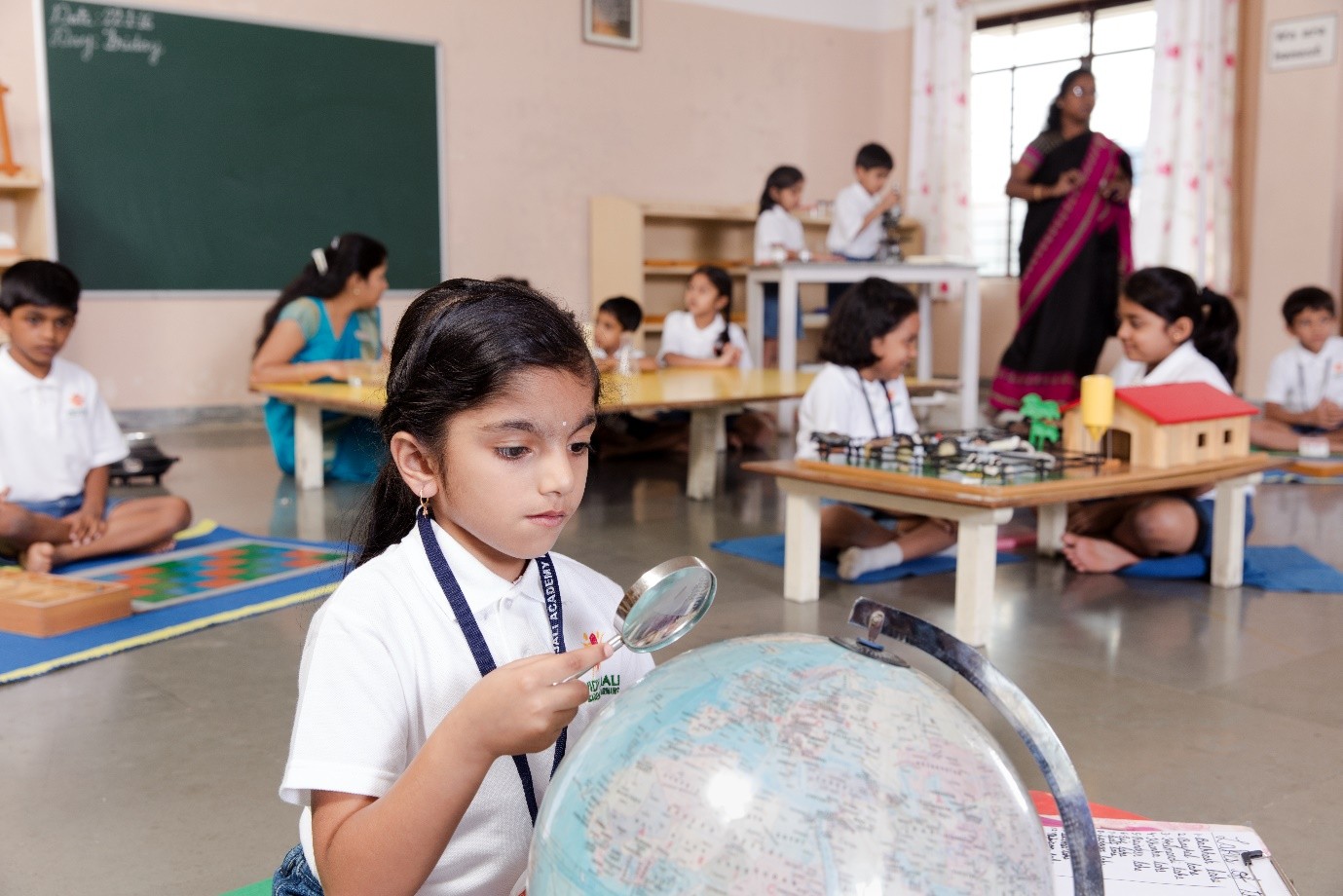
Vidyanjali
merges the child-centred values of the Montessori method with the structured
learning and academic rigour of the Central Board of Secondary Education
(CBSE). Social studies here is not confined to textbooks; the school aims to
nurture globally competent and socially responsible citizens.
●
Lessons are designed to build
not only knowledge of geography, history, and civics but also empathy, social
awareness, moral values, and respect for diversity.
●
Through group activities,
projects, and collaborative learning, children learn to see issues from
different perspectives, to discuss and reflect, building social and emotional
intelligence along with academic skills.
●
Mixed-age learning
environments, especially in the primary Montessori years, encourage peer
learning, mentoring, and collaboration, enriching social studies with social
interaction.
●
Many teachers have advanced
qualifications; a good proportion hold master’s degrees, and most are
professionally trained. With a focus on small class sizes and attentive
observation, educators ensure children are supported academically, emotionally,
and socially.
If you
are a parent or student looking for a school where social studies is taught
with heart, purpose, and depth, Vidyanjali offers an environment that nurtures
not only academic success but also socially conscious, compassionate, and
confident young individuals.
To learn
more about how Vidyanjali Academy helps children understand the world and grow
into socially aware individuals from the early years, contact
us.