
When you
walk into a primary science classroom at Vidyanjali Academy, learning does not
begin with a textbook definition on the board. It often begins with a question:
Why do leaves change colour? What happens if we mix water and air? How does a
seed become a plant?
Children
gather around simple materials, observe closely, discuss what they see, and
slowly begin to build ideas through experience. This is at the heart of how
science is taught in primary school today, not as memorised facts but as a way
of thinking, observing, questioning, and understanding the world.
This page
offers a clear look at why science matters in primary education, how it is
taught, and how Vidyanjali Academy nurtures young scientific minds.
Why is Science Important in Primary Education?
Children are natural scientists. From a very young age,
they are encouraged to experiment with water, light, sound, movement, and
materials around them. Early exposure to science helps children use their
natural curiosity to learn better.
Beyond that, here is why it is an essential part of
primary education:
●
Cognitive and
problem-solving skill development: Primary science
education strengthens core thinking skills such as observing patterns,
comparing differences, predicting outcomes, and drawing simple conclusions.
These abilities form the foundation for logical reasoning and later academic
problem-solving across subjects, not just in science.
●
Curiosity, Observation, and
Questioning Skills: High-quality instruction does
not rush children to the right answers. Instead, it encourages them to ask why,
how, and what if. Over time, children learn that questioning is not a sign of
ignorance but the beginning of understanding.
●
Relevance to Real-Life
Experiences: Unlike many abstract subjects, primary
science is closely connected to daily life (plants in the garden, water in the
tap, air we breathe, weather outside the window, and the human body itself).
Children begin to see that science is not limited to classrooms; it explains
the world around them.
What Are the Goals of Teaching Science at the Primary Level?
A key aim
of early science education is to nurture a scientific temper, the habit of
thinking rationally, questioning assumptions, and seeking evidence before
forming conclusions. This aligns closely with India’s National Education Policy
(NEP) 2020, which emphasises critical thinking and inquiry from the
foundational grades.
Here are
a few more goals of teaching science at the primary level:
●
Fostering inquiry and
exploration: Rather than delivering information,
teachers guide children to explore concepts through simple investigations and
observations. Learning becomes a process of discovery rather than memorisation.
●
Promoting evidence-based
thinking: Children begin to understand that ideas
in science are supported by observation and evidence. They learn to explain
their thinking and listen to the reasoning of others.
●
Building foundational STEAM skills: Early
science education lays the groundwork for later learning in Science, Technology,
Engineering, Arts, and Mathematics Skills such as measuring, classifying, predicting, and modelling
develop gradually through hands-on work.
How do Schools Teach Science to Young Children?
In progressive primary schools, science is taught
through a blend of carefully chosen methods that respect the child’s
developmental stage. Here is a closer look:
●
Inquiry-based learning: Children observe, ask questions, suggest explanations, and test
ideas. The teacher acts as a guide, not merely an instructor. This approach
builds confidence; children feel their questions matter and that figuring
things out can be exciting.
●
Activity-based learning: Concepts are introduced through simple activities (growing plants,
testing objects that float or sink, observing shadows, or mixing substances
safely under supervision). Children learn faster when they can see something
happen in front of them rather than imagine it, making science feel real and
reachable.
●
Thematic learning: Science themes are often integrated with stories, language, art, and
social studies. A theme like Water may include evaporation experiments, water
conservation discussions, rain poems, and art activities based on water bodies.
This helps children see that science isn’t a separate “subject”; it’s part of
everyday life, making learning more joyful.
●
Experiential methods: Learning is rooted in direct experience (touching, seeing, hearing,
and doing). Abstract explanations come later, once the child has a concrete
understanding. This builds a deep, lasting understanding as children remember
what they’ve experienced, not what they’ve been told.
Primary science is clearly cross-disciplinary. It
interlinks with environmental studies, social context, art, and language, so
children can see holistic connections. For example, mathematics is used for
measuring, language for explaining observations, and art for drawing scientific
processes, integrating science with everyday life.
What Teaching Methods Are Most Effective in Primary School?
Simple experiments (rather than high-tech lab
experiments) help children understand cause and effect. Here are some other
effective age-appropriate teaching methods:
●
Storytelling and analogies: Teachers often use stories and metaphors to explain abstract ideas.
For example, comparing the heart to a pump or the roots to drinking straws.
●
Use of nature walks and
local context: Leaves, soil, insects, clouds, and
water sources become living learning tools. Children learn best when science
connects to what they can see around them.
●
Group projects and peer
learning: Working in small groups teaches children
to share ideas, listen to others, and build collective understanding.
●
Concept mapping and models: Visual tools such as charts, diagrams, clay models, and flow charts
help children organise and remember what they have learned.
All of these align with the constructivist approach in
science teaching, where children actively construct knowledge through
experience and build their own mental models of how things work rather than
passively receiving information.
How Do Teachers Assess Science Learning in Primary School?
Assessment in primary science goes far beyond formative
tests (which happen continuously through observation, class participation, and
everyday work) and summative tests (which are more structured and usually
appear as term-end evaluations). Here is how we go about it:
●
Observation-based
assessment: Teachers closely observe how a child
handles materials, asks questions, explains ideas, and works independently or
with peers.
●
Portfolio and project work: Children maintain simple science notebooks, drawings, and small
projects that reflect their progress over time.
●
Quizzes and concept-based
tests: Short quizzes focus on understanding rather
than memorised definitions.
●
Oral questioning and
discussions: Many insights into a child’s learning
come through simple classroom conversations.
What Role Do Parents Play in Science Learning at Home?
Parents
are often a child’s very first science guides, the ones who spark wonder long
before any classroom does. Here’s how you can help:
●
Encouraging Questions and
Curiosity: When a child suddenly asks, “Why is the
sky blue?”, it’s an invitation to explore the world together. Maybe you both
sketch little diagrams on a notepad, step outside to observe the sky, or play
with a torch and a glass of water to mimic light scattering. These tiny shared
adventures make curiosity feel exciting, not intimidating.
●
Helping with Small
Experiments: From watching a seed sprout on the
windowsill to filtering muddy water through cotton and sand, to mixing colours
or measuring how much it rained last night, simple, hands-on experiments turn
everyday moments into science lessons. They show children that learning isn’t
something that only happens at school.
●
Watching Educational Videos
Together: Age-appropriate science videos,
animations, or simulations can make big ideas feel graspable. When parents
watch along, pause, laugh, and discuss what’s happening, it becomes a shared
learning moment, not just screen time.
●
Visiting Science Museums or
Nature Parks: A walk through a science museum, a
planetarium show, or even a quiet hour in a nature park can ignite questions
and fascinations that last for years. Real-world exposure gives children
stories, visuals, and memories that make science feel alive.
How Does Vidyanjali Academy Stand Out in Science Education?
At the
heart of Vidyanjali’s approach lies a simple belief: children learn best when
they engage actively, explore meaningfully, and connect subjects to their
world. The school’s broader mission, shaping globally competent and socially
responsible citizens through a Montessori-inspired, activity-based pedagogy,
sets the tone for science as well.
Here is
how Vidyanjali brings science alive for young learners:
●
Inquiry-Driven and
Child-Centred Learning: Rather than treating
science as a subject to finish, Vidyanjali treats it as a field to explore.
Classrooms and labs provide students with the freedom to observe, question,
experiment, and draw their own conclusions, fostering curiosity and a genuine
love for learning. This approach respects each child’s pace, encourages
hands-on exploration, and develops critical thinking from an early age.
●
Highly Qualified and Trained
Science Educators: Quality science education begins
with passionate and well-trained teachers. At Vidyanjali, many educators hold
postgraduate qualifications, and a significant proportion have more than ten
years of teaching experience, ensuring maturity, expertise, and dedication in
guiding students.
●
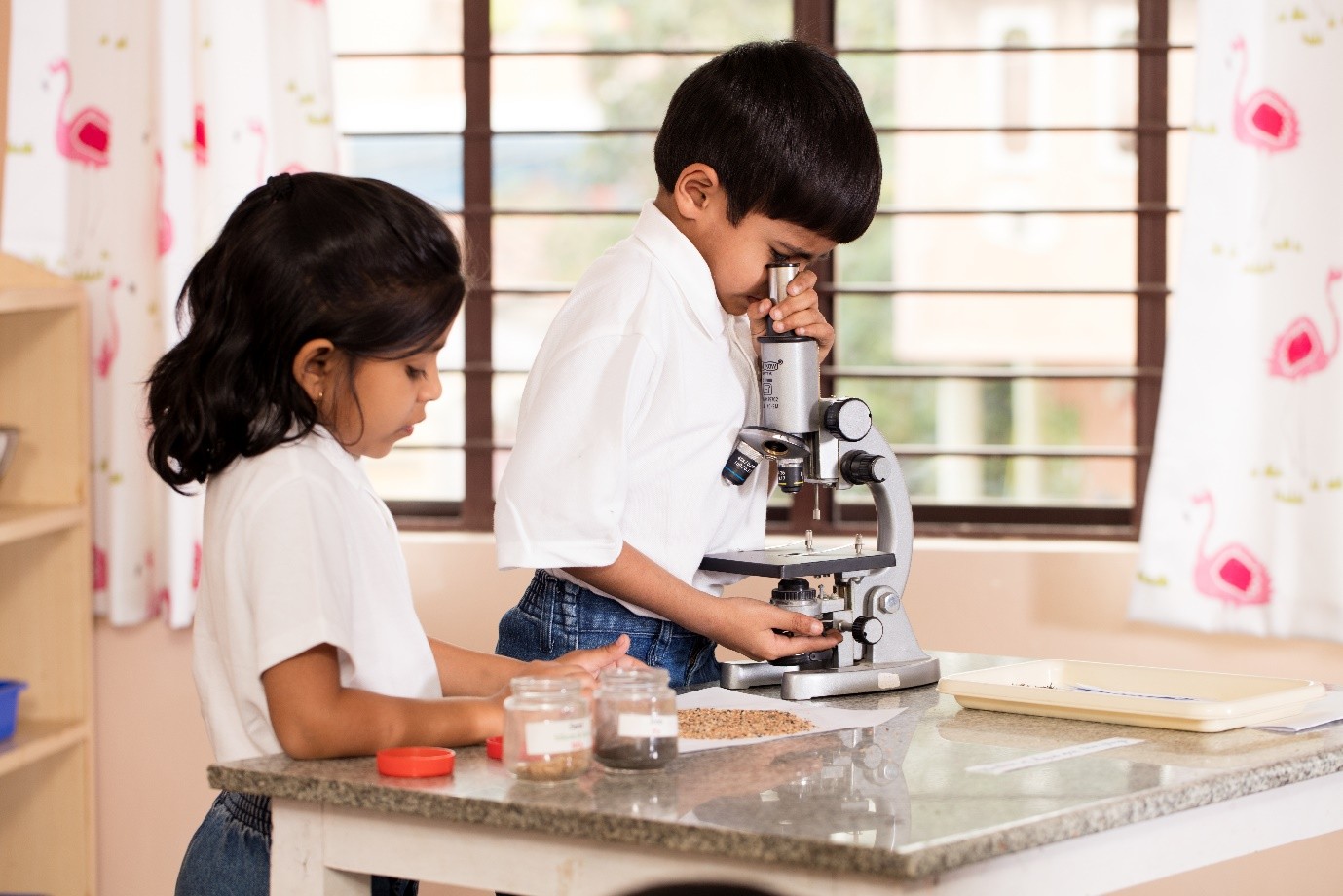
Integration of Labs and
Experiential Tools from Grade 1: Unlike many
schools where science becomes practical only in later grades, Vidyanjali
integrates laboratory-based and experiential science learning early on. The
school’s modern infrastructure includes well-equipped science laboratories
where children can observe, experiment, and understand scientific concepts
through real materials, not only theory.
●
Use of Technology and
Real-World Examples: Vidyanjali’s classrooms are
equipped with smart boards, projectors, and digital learning tools, enabling
teachers to present vivid visuals, simulations, and real-world examples that
strengthen scientific understanding.
●
Aligned with NEP 2020 and
CBSE Curriculum: While Vidyanjali’s roots are in
Montessori and activity-based education, the primary and secondary programmes
transition smoothly into the framework of the Central Board of Secondary
Education (CBSE), ensuring academic rigour along with hands-on learning.
●
Student Science Exhibitions
and STEAM Clubs: Vidyanjali does not limit science to classwork. Through dedicated
STEM and innovation labs, students engage in creative projects, robotics,
coding, and hands-on experiments, all within a safe, guided environment.
Programmes like CREYA Learning foster Science, Technology, Engineering, Arts, and
Mathematics (STEAM) skills, encouraging exploration, leadership, decision-making, and
collaborative problem-solving.
With this
kind of foundation, Vidyanjali ensures children don’t just learn science, they
experience it. Here, a simple question can turn into a mini-investigation, and
a classroom moment can spark a lifelong fascination. It’s the kind of
environment where young minds feel empowered to explore, experiment, and
imagine without limits.
To explore how Vidyanjali Academy nurtures scientific minds from the early years, contact us.
1.
At what age should
science education begin?
Science
education, in the sense of observation, curiosity, and exploration, can begin
as early as primary school (Grade 1 or even earlier) through simple
experiments, observation of nature, and discussions. This lays a foundation for
scientific thinking.
2.
Do all primary schools
follow the same science syllabus?
Not
necessarily. While many schools follow the CBSE syllabus or state board
syllabus, the approach to teaching, whether theory-only or experiential and
inquiry-based, can vary widely between schools.
3.
How often is science
taught in a week?
In most
primary schools, science is taught three to four times a week, although this
can vary depending on the class schedule and curriculum. Schools focused on
experiential learning often integrate science into other activities, making it
part of daily learning rather than a single subject.
4.
Is practical learning
better than theory in early science education?
Yes,
especially in the early years. Practical, hands-on learning helps children
build concrete understanding, fosters curiosity, sharpens observation skills,
and makes abstract concepts easier to grasp. Many research studies support that
inquiry-based, practical science teaching improves engagement, conceptual
clarity, and scientific thinking.