


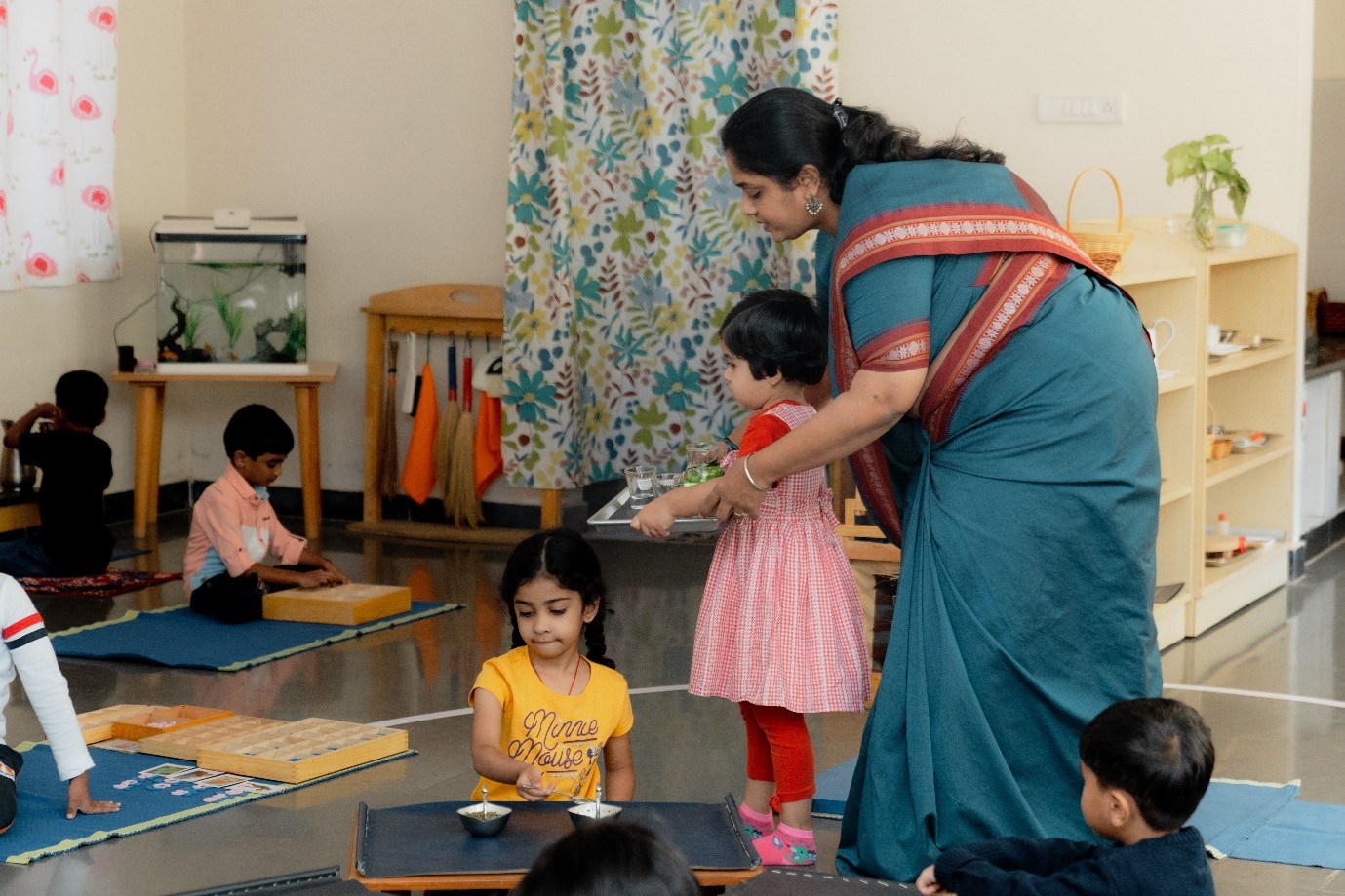
When parents choose Montessori education, they aren’t just choosing a different classroom layout or set of materials. They’re choosing a very different kind of adult in the room. In a true Montessori environment, the teacher is not the person who stands at the front and “delivers” lessons to the whole class; instead, they quietly design, observe, and guide each child’s journey.
At
Vidyanjali Academy for Learning, Montessori teachers play a central role in
shaping the calm, purposeful, and joyful atmosphere you see in the pre-primary
and primary Montessori classrooms. Their work is grounded in Dr Maria
Montessori’s philosophy and strengthened by Vidyanjali’s own in-house training
through the Vidyanjali Montessori Training Institute (VMTI).
This page
explores what Montessori education means at Vidyanjali, what Montessori
teachers actually do every day, and why their role is so important for
your child’s development.
What is Montessori education at Vidyanjali?
Montessori
education is a child-centred approach where children learn through hands-on
materials, freedom within clear limits, and a carefully prepared environment.
Vidyanjali Academy follows the core principles of Montessori education in its
early years, offering a structured Montessori curriculum from pre-primary
onwards and extending it into the primary level.
In
practice, this means:
● Children work with specialised materials in language, mathematics,
science, geography and culture at their own pace.
● Classrooms are designed for independence: low shelves, child-sized
furniture and clearly arranged materials.
●
Learning is child-led and
activity-based, with teachers guiding rather than controlling every step.
A Primary Montessori classroom at Vidyanjali
typically includes up to 35 children aged 2.5 to 5.5 years with two teachers,
which allows for mixed-age learning and peer support while keeping adult
guidance available when needed.
What is the role of a Montessori teacher at Vidyanjali?
In a
traditional classroom, the teacher is usually the centre of attention. In a
Montessori classroom at Vidyanjali, the child is the centre, and the
teacher is the facilitator who makes deep, independent learning
possible.
A
Montessori teacher at Vidyanjali:
● Designs and maintains the prepared environment
● Connects each child with the right material at the right time
● Observes quietly to understand interests, strengths, and challenges
● Steps in with gentle guidance instead of constant instruction
● Models respect, order, and calm rather than top-down authority
This is
why Montessori teachers at Vidyanjali are often described as guides.
They lead by example, by the quality of their attention, and by the way they
protect each child’s curiosity and dignity.
Key responsibilities of a Montessori teacher
Although
the classroom looks peaceful and child-led, the teacher’s role is highly active
and intentional. At Vidyanjali, Montessori teachers carry several core
responsibilities:
1. Facilitating learning experiences
Teachers present Montessori materials individually or
in small groups, demonstrating how to use them and then stepping back so
children can practise independently. They plan sequences of lessons across
language, maths, sensorial work, practical life, science and culture.2. Observing children’s progress
Observation is a daily practice. Teachers watch how
long a child concentrates, which materials they choose, how they interact with
peers, and where they may need support or more challenge. This observation
informs every decision about what to present next.3. Preparing and protecting the environment
From the layout of shelves to the condition of each material, the classroom environment is part of the “lesson”. Teachers ensure materials are complete, attractive, and accessible, and that the room stays orderly and calm so children can focus.4. Fostering independence and
self-discipline
Instead of doing tasks for children, teachers show them how to do
things themselves, pour water, roll mats, choose work, and tidy up. Clear
ground rules and natural consequences help children develop inner discipline
rather than relying on external rewards or punishments.How Montessori teachers support child development
At
Vidyanjali, the role of the Montessori teacher is deeply connected to holistic
development, cognitive, social, emotional and even physical growth.
● Cognitive development & critical thinking
By encouraging children to explore materials, test ideas and repeat activities
until satisfied, teachers help build concentration, problem-solving skills and
logical thinking. Research from Vidyanjali’s own founder-director has shown
that students with Montessori backgrounds often demonstrate stronger higher-order thinking in English and science
compared to non-Montessori peers.
● Social skills and collaboration
Mixed-age groups allow older children to naturally
mentor younger ones, while younger children learn by observation. Teachers
gently facilitate group projects, “going out” experiences and classroom
responsibilities that require cooperation.
● Emotional resilience and confidence
Since work is self-chosen and feedback is immediate (through the material
itself), children learn to persevere, correct their own mistakes and take pride
in genuine mastery. Teachers support this process with calm reassurance rather
than pressure.
What skills and qualifications do Montessori teachers at Vidyanjali need?
Vidyanjali
places strong emphasis on specialised Montessori training for its
teachers. The school’s own Vidyanjali Montessori Training Institute (VMTI),
established on campus, offers structured Montessori teacher education and is
affiliated with the Indian Institute for Montessori Studies (IIMS) since 2011.
The
leadership behind this training is experienced and highly qualified, Dr Shashi
Rekha Reddy, founder-director of Vidyanjali and director of VMTI, holds
diplomas in both pre-primary Montessori (Association Montessori Internationale)
and primary Montessori training, along with advanced Montessori director
training.
Beyond
certificates, Vidyanjali looks for adults who can genuinely thrive in a
Montessori environment. Key qualities include:
● Patience and calm presence
● Strong observational skills
● Respect for each child’s pace
● Empathy and emotional steadiness
● Love of learning and openness to feedback
These
qualities allow teachers to create the nurturing, structured and joyful spaces
that Vidyanjali repeatedly emphasises in its communication about Montessori
education.
What should you expect from Montessori teacher training at Vidyanjali?
Vidyanjali
Montessori Training Institute (VMTI) offers a range of programmes and workshops
for aspiring and practising teachers:
●
Short workshops and free
orientations that introduce Montessori principles and classroom practice.
●
Part-time certificate
courses, historically run over a few months,
focusing on primary Montessori work (ages roughly 6–9) across core subjects.
●
Online diplomas such as the
Montessori 6–9 Diploma, designed to train teachers
for Montessori work in Classes I–III.
How do Montessori teachers manage their classrooms?
Classroom
management in Montessori looks very different from a traditional “quiet rows”
model. At Vidyanjali, you’ll see children moving, choosing work and talking
softly, yet the room feels peaceful and purposeful, not chaotic.
Montessori
teachers maintain this environment by:
Establishing clear, consistent ground
rules (walk, don’t run; speak softly; return work as you found it).
● Using observation to notice when a child needs redirection or a
new challenge, instead of raising their voice or relying on punishments.
● Offering choices within limits, which builds responsibility (“Would you
like to work with the bead material or the stamp game next?”).
● Encouraging children to solve small problems themselves first,
stepping in mainly to model language or restore safety.
Discipline,
in this setting, is not about control; it is about helping children build inner
discipline, the ability to choose right actions even when no adult is
watching.
What is the salary and job outlook for Montessori teachers?
Montessori-trained
teachers working in established schools and training centres have a steady
and growing demand, especially in cities like Bengaluru where parents
actively seek alternative, child-centred education.
Actual
salaries vary depending on:
● Location and type of institution
● Years of experience
● Level (pre-primary vs. primary, assistant vs. lead teacher)
● Additional responsibilities (coordination, training, curriculum design)
Graduates
of programmes like those at Vidyanjali Montessori Training Institute often find
opportunities in:
● Montessori environments within Vidyanjali Academy itself
● Other Montessori schools and early childhood centres across India
●
Primary schools that value
Montessori-informed approaches in the early grades
For the
most accurate, updated information on roles and openings, Vidyanjali
periodically shares career notices, including specific Montessori
teacher positions, on its official channels.
What are the benefits of Montessori education, and why is the teacher’s role so crucial?
Montessori
education at Vidyanjali is built around individualised learning, respect
for the child and a carefully prepared environment. When the teacher’s role is
understood and executed well, this leads to:
● Children who feel confident choosing work and following their interests
● Strong foundations in language, mathematics, science and culture
● Deep concentration and genuine enjoyment of learning
● Better readiness for later CBSE grades and beyond
What is the difference between a Montessori teacher and a traditional teacher?
A
traditional teacher usually directs the whole class together, explains content
from the front and evaluates mainly through tests. A Montessori teacher at
Vidyanjali prepares the environment, presents materials individually or in
small groups, and then steps back so children can work at their own pace.
Observation, guidance, and respect for independence replace constant
instruction.
How do Montessori teachers manage children’s behaviour without rewards or punishments?
Instead
of stickers and scoldings, Montessori teachers focus on clear rules, natural
consequences and meaningful work. When children are engaged in work that
matches their level, most misbehaviour naturally reduces. Teachers quietly
redirect, offer new challenges or involve a child in helpful tasks, aiming to
build self-control rather than compliance.
How long does it take to become a Montessori teacher?
Timeframes
vary by course. At Vidyanjali Montessori Training Institute, there have been short-term
workshops, three-month part-time certificate courses, and longer
diploma programmes (such as the Montessori 6–9 Diploma) designed for those who
want to work with specific age groups. Prospective teachers can choose a path
based on their goals and availability.
Can Montessori teachers work in traditional schools?
Yes. Many
skills developed in Montessori training, observation, classroom organisation,
and differentiated instruction are valuable in any school setting. However,
teachers who wish to practise the full Montessori method often prefer
Montessori or Montessori-inspired environments like those at Vidyanjali, where
the materials, schedules and philosophy fully support this way of working with
children.
Why do Montessori teachers avoid grades and frequent testing in early years?
Montessori education emphasises intrinsic motivation, the child’s own satisfaction in mastering a skill, rather than learning for marks. In the early years at Vidyanjali, teachers rely more on continuous observation, recorded progress and the child’s work itself rather than frequent formal tests. This helps children stay curious and confident, instead of anxious about performance. As they move into higher grades, assessment becomes more structured and aligned with CBSE requirements.