


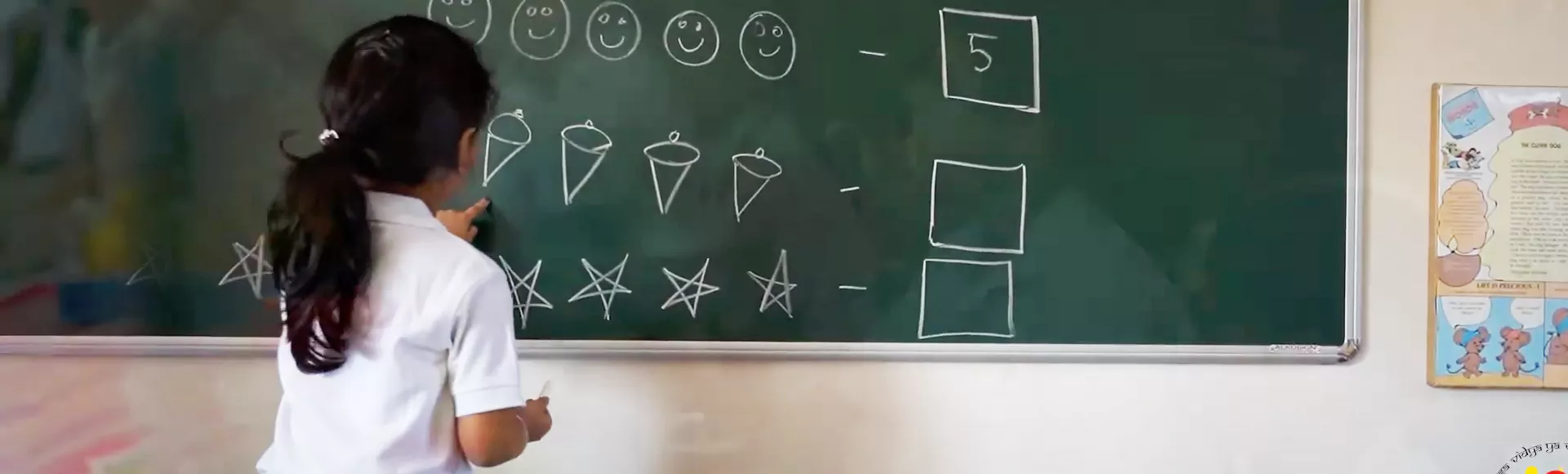
At
Vidyanjali Academy, children don’t just learn math; they experience it. The goal isn’t to memorise formulas but to
understand how numbers describe the world around them. Using hands-on
materials, visual exercises, and self-paced exploration, children develop a
natural sense of numbers from an early age.
This
way of learning goes beyond arithmetic. It helps children think clearly, solve
problems confidently, and notice patterns in everyday situations. In Montessori
math, learning starts with touch and observation. Instead of beginning with
symbols or equations, children handle materials like number rods, golden beads,
and spindle boxes. These tools help them see and feel how numbers work. Over
time, this turns abstract math into something real and easy to grasp.
What Is Montessori Math?
The
Montessori math approach is fully hands-on and moves at your child’s own pace.
Children don’t rush through lessons; they move forward when they’re ready,
driven by curiosity rather than pressure. They begin by working with real,
tangible materials and gradually learn to understand abstract ideas like place
value, decimals, and arithmetic operations. This steady progression keeps
learning calm and natural while helping real understanding take root.
Dr
Montessori believed that all learning should move from the concrete to the
abstract. In math, this means your child must first touch, move, and explore
before they can grasp concepts in their mind. By the time they start solving
problems on paper, they’ve already built a strong base through years of active,
hands-on exploration.
What
Is the Importance of Mathematics in Montessori Education?
In
Montessori education, math is part of daily life, not a tough or separate
subject. Children explore it naturally through everyday tasks like pouring,
sorting, or measuring. These small activities help them understand math by
doing, long before formal lessons begin.
Math
also connects with other Montessori areas. When children stack blocks or
arrange utensils, they learn about size, order, and quantity. Such experiences
build the base for later abstract work.
With
tools like number rods and bead chains, children move from hands-on tasks to
real math operations. They don’t just memorise steps, they see how numbers
work.
Montessori
math focuses on understanding and curiosity. Children experiment, make
discoveries, and build confidence. Over time, this approach strengthens their
problem-solving and reasoning skills well beyond the classroom.
What Are the Core
Principles of Montessori Math?
At
Vidyanjali Academy, Montessori math is structured to help children truly
understand numbers, not just memorise them. Four key principles guide this
approach:
1. Concrete to Abstract Learning
Children
begin with physical materials, bead chains, number rods, and golden beads to
explore math through touch and movement. Only once they’ve built a real
understanding do they transition to abstract symbols and equations. This makes
even advanced math feel natural and intuitive.
2. Self-Correction and Independence
All
materials include a built-in control of
error, so children can identify and fix mistakes on their own. This reduces
dependence on teachers and builds quiet confidence in their problem-solving
skills.
3. Repetition and Mastery
There’s
no rush to move on. Children are encouraged to repeat math activities as many
times as needed. This repetition strengthens understanding and helps concepts
stick, without pressure or comparison.
4. Responsibility for Learning
The
design of the materials and the structure of the classroom support ownership. Children take responsibility
for their pace, their corrections, and their outcomes. The result: math becomes
something they own, not something
done to them.
How Is Math Taught in a Montessori
Classroom?
In
Montessori math, children learn through guided demonstrations, hands-on
materials, and their own pace of progress. The teacher first shows how a
material works and explains what it represents. After that, you’re free to
explore it yourself, repeat the activity, and return to it until you fully
understand the concept.
Each
material in the classroom builds naturally on what comes before. You might
start by counting with number rods, then move on to adding beads, and later
practice complex operations with the stamp game. Montessori math centres on
exploration. You get to handle the materials, notice patterns, and test how
numbers work. This hands-on process doesn’t just teach math, it builds
curiosity and genuine understanding of how numbers fit together.
What Are the Most Common Montessori
Math Materials?
Montessori
math employs a wide range of materials, each designed to teach specific
concepts:
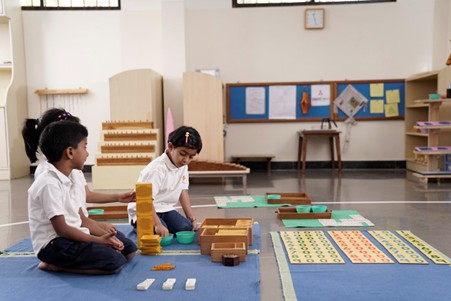
Golden
Beads: Represent units, tens, hundreds, and
thousands, helping children understand the decimal system through tangible
manipulation.
●
Number Rods: Visual and tactile rods used for
counting, addition, and subtraction.
●
Spindle Boxes: Teach counting and number
recognition by inserting spindles into boxes labelled with numbers.
●
Stamp Game: Helps children perform
addition, subtraction, multiplication, and division in a hands-on way.
●
Bead Chains: Used to teach skip counting,
multiplication, and the concept of squares and cubes.
●
Decimal System Materials: Introduce the
idea of units, tens, hundreds, and thousands, facilitating an understanding of
place value.
Each
material allows children to internalise concepts through physical interaction,
bridging the gap between concrete experience and abstract understanding.
When and How Is Math Introduced in
Montessori by Age?
For
infants and toddlers, math is introduced through sensorial foundations such as
order, sequence, and classification. Daily routines provide opportunities to
introduce quantity and basic counting, such as placing toys in order, stacking
blocks, or distributing snacks. Activities like matching objects and observing
patterns lay the groundwork for mathematical thinking, even before formal
number concepts are taught.
What Math Concepts Are Introduced in
Early Childhood (3–6 Years)?
During
early childhood, children explore counting, number recognition, and basic
operations using concrete materials. Golden beads and the decimal system are
introduced to help learners grasp the concept of place value. Children engage
in activities like counting objects, adding and subtracting beads, and
arranging numbers in sequence. These experiences emphasise concrete, hands-on
learning, ensuring that mathematical concepts are meaningful and memorable.
How Does Montessori Teach Math in
Lower Elementary (6–9 Years)?
In
lower elementary, children begin to transition to more abstract operations.
They use materials like the stamp game to explore addition, subtraction,
multiplication, and division. Fractions, measurement, and word problems are
introduced through real-life applications, connecting mathematical concepts to
everyday experiences. This stage emphasises problem-solving, reasoning, and the
application of math beyond rote exercises.
What Advanced Math Is Taught in Upper
Elementary (9–12 Years)?
Upper
elementary students delve into algebraic thinking, geometry, and advanced
measurement concepts. Materials such as bead chains for squaring and cubing,
fraction charts, and geometric solids are used to develop conceptual
understanding. Abstract thinking is emphasised over memorisation, allowing
children to explore patterns, relationships, and problem-solving strategies in
depth.
What Math Concepts Does Montessori
Emphasise?
Montessori
math helps children truly understand how numbers and operations work. Through
hands-on materials and real activities, they explore ideas like place value,
addition, subtraction, multiplication, division, fractions, and geometry. This
approach lets them see why each
operation works, instead of just memorising steps.
Sensorial
learning is central to Montessori math. Children use tactile, visual, and
manipulative materials to internalise abstract concepts. For example, golden
beads teach place value visually and physically, while number rods allow
children to feel differences in quantity. These sensorial experiences create
strong neural pathways, enhancing comprehension and retention of mathematical
ideas.
What Are the Benefits of Learning
Math the Montessori Way?
Montessori
math fosters independence, confidence, and critical thinking. Children develop
a strong foundation in numerical understanding, problem-solving, and logical
reasoning. The approach encourages curiosity and intrinsic motivation, as
learners explore concepts through meaningful, hands-on experiences rather than
rote memorisation.
What Research Supports
the Effectiveness of Montessori Math?
Research,
including studies by Lillard and colleagues, has demonstrated that Montessori
students often outperform peers in mathematical reasoning and conceptual
understanding. Montessori learners show higher achievement in problem-solving,
spatial reasoning, and long-term cognitive development. The approach also
supports socio-emotional skills, such as independence, self-regulation, and
perseverance.
Is Montessori Aligned with Common
Core?
Montessori
math can align with Common Core standards, though the approach may differ in
sequence and methodology. The hands-on, conceptual approach can meet or exceed
the rigor of Common Core objectives while fostering a deeper understanding of
mathematical principles.
Can Montessori Math Be Used at Home?
Yes,
Montessori math can be adapted for home environments. Simple materials, such as
counting beads, number rods, and everyday objects, can be used to teach
foundational concepts. Parents can follow a child-led approach, providing
guidance and opportunities for exploration rather than imposing structured
lessons.
What Comes Next in the Montessori
Mathematical Journey?
As
children progress, Montessori math continues to expand into more complex areas,
such as algebra, advanced geometry, and applied problem-solving. By fostering a
strong conceptual foundation early on, Montessori learners are well-equipped to
tackle advanced mathematical challenges with confidence and understanding.
The Lasting Impact of Montessori Math
Montessori
math goes beyond teaching numbers and operations. It helps children understand
how learning truly works. Through hands-on materials and guided discovery, they
learn to think independently rather than simply memorise facts.
Each
activity encourages problem-solving, reasoning, and focus. As children explore
and make sense of what they see, they grow more confident in applying their
knowledge.
By
connecting sensory experiences, practical life skills, and academic lessons,
Montessori math turns complex ideas into something children can touch and
understand. It lays the foundation for both academic growth and everyday
problem-solving.