

When you
choose a Montessori program, you’re not just choosing a school, you’re choosing
a way of looking at childhood. In a true Montessori environment, children are
encouraged to explore, make choices, and grow into independent, thoughtful
human beings. But this doesn’t happen in the classroom alone. It becomes
powerful when school and home work together.
At
Vidyanjali Academy for Learning, Montessori is not a “pre-school label”; it is
the heart of early education. The school’s own philosophy is clear: a child
learns best when parents are actively involved in the learning process. That’s
why Vidyanjali invests and invites parents to attend and participate in Parent
orientations, workshops, Parent Presentations, Parent-teacher meetings, Parent
Empowerment Days and Parent Observation, Parent Involvement programmes, to keep
families closely connected to what happens in the Montessori environments.
This page
will walk you through what Montessori education looks like, what your role as a
parent truly is, and how you can support your child at Vidyanjali, both in
school and at home.
What is Montessori education at Vidyanjali?
Montessori
education is a child-centred approach developed by Dr. Maria Montessori. It is
built on a few core ideas:
● Children learn best through hands-on
exploration.
● They thrive in a carefully prepared
environment where everything has a purpose.
●
They develop independence and
inner discipline when given freedom within clear limits.
At
Vidyanjali Academy for Learning, this philosophy guides the Primary and
Lower Elementary, with dedicated Montessori environments and trained
Montessori staff. The school is recognised in respected Montessori directories
and associations, with age levels spanning 3–6, 6–9 in Montessori and beyond
in CBSE, indicating a strong and structured Montessori foundation.
Why is parent involvement so important in Montessori?
Montessori
is based on consistency. Children feel secure and grow best when the
messages they receive at home and at school are aligned.
Vidyanjali’s
own communication puts it simply: the school believes a child “should also “needs
to learn from their parent,” and so the team actively involves parents through
workshops, meetings and events.
From a
Montessori point of view, parent involvement matters because:
●
Your child doesn’t separate
“school life” and “home life” the way adults do.
●
Research across different
systems (including Montessori) consistently shows that parental involvement
is linked to better engagement, achievement and long-term outcomes.
When
parents and teachers work together, children receive the same message:
“We believe you are capable. We trust you. We will guide you, not
control you.”
What is the role of parents in Montessori education?
Living the Montessori
philosophy at home
In a
Montessori setting, parents are not just “supporters” who help with homework.
You are co-educators. Your role is to extend the same philosophy your
child experiences at Vidyanjali into daily life:
● Respect your child as a person.
Listen to their ideas, give them time to speak, and
involve them in real tasks instead of entertaining them constantly and
interfering in their tasks, which they are capable to do.
● Encourage independence.
Let your child try first, whether it’s buttoning a
shirt, pouring water, or packing their bag. Step in only when truly needed.
● Offer freedom within limits.
Give choices that are reasonable: “Would you like to
wear the blue t-shirt or the green one today?” This mirrors the classroom,
where children choose work within clear boundaries.
How can parents support their child’s learning and development?
Here are
some Vidyanjali-aligned ways to support your child’s Montessori journey:
1. Create simple routines.
Have predictable times for waking,
meals, school, play and sleep. Children are calmer and more focused in
environments with clear, gentle structure.
2. Offer real responsibilities.
Ask your child
to lay the table, water plants, wipe a small spill, or sort laundry by colour.
These “practical life” tasks build concentration, coordination and pride.
3. Limit unnecessary help.
If your child is struggling a bit, wait.
You can say, “Would you like a little help, or would you like to try again?”
This mirrors the way teachers at Vidyanjali guide rather than rescue.
4. Protect focused time.
When your child
is deeply absorbed in drawing, building, or working with a puzzle, avoid
interrupting unless necessary. This uninterrupted concentration is central to
Montessori learning.
5. Model calm behaviour.
Children copy
what they see. If you speak respectfully, manage frustration with care, and
treat others kindly, you are giving the “grace and courtesy” lessons Montessori
classrooms are known for.
Building a strong partnership with Vidyanjali teachers
Communication that supports your child
Vidyanjali
puts visible effort into building a parent–school partnership through:
● Regular parent–teacher meetings and workshops
●
Montessori-specific Parent
Presentation sessions that explain classroom practices
●
Special events like Parent
Orientation and Parent Empowerment Day, focused on guiding parents
of particular grades.
Vidyanjali
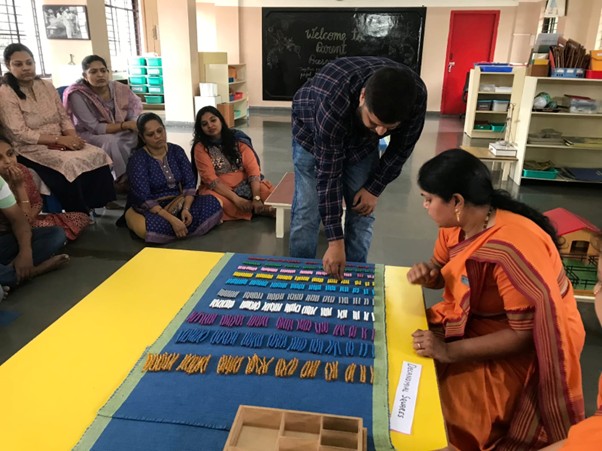
also hosts Open House events and Admission process based personal tours,
where parents can see the environments and understand how Montessori materials
are used. These are valuable opportunities to connect what you’ve heard in
meetings with what you see in the classroom.
Getting actively involved in Montessori school life
Participating in school events and activities
When you
participate in school life, your child sees that you value their environment.
At Vidyanjali, this can include:
●
Attending Parent Orientation,
Presentation, Empowerment Day, Observation, Graduation Day, where
the focus is on helping you understand teaching methods and developmental
milestones.
● Joining Open House / FUN-W-FAMILY and similar events that
showcase Montessori environments, student work and interactive activities.
●
Being present for celebrations,
presentations and class events when invited.
These
moments send a strong message to your child: “What you do at school matters to
our family.”
Home–school partnership activities
You can
also build partnership in quieter, everyday ways:
● Read school circulars, newsletters and blog posts about Montessori at
Vidyanjali and discuss them at home.
● Work on simple, school-aligned projects together when sent home, for
example, talking about a theme, exploring nature, or creating a small display.
●
Use similar language to school
(for example, “Can you put your work back in its place?”) to maintain
consistency.
Bringing Montessori practices at home
Montessori activities you can do at home
You don’t
have to buy an entire set of classroom materials. At home, you can start with
everyday, hands-on tasks that encourage independence and thinking:
●
Practical life: pouring water from a small jug to a glass, spooning dry grains from
one bowl to another, folding small towels, watering plants, cleaning a low
table.
● Order and care: arranging books on a low
shelf, sorting toys into baskets, setting out shoes neatly, putting dirty
clothes in a basket.
● Sensorial exploration: sorting buttons by
size, matching lids to containers, exploring textures (smooth/rough/soft),
smelling herbs or spices together.
These
simple tasks mirror the goals of Montessori materials, coordination,
concentration, independence and problem-solving, but with items you already
have.
Using Montessori materials at home, carefully
If you do
choose to purchase some Montessori-inspired materials (like knobbed cylinders,
sandpaper letters, or simple number rods), keep in mind:
●
Less is more. Offer a few
materials at a time on low shelves, not overflowing boxes.
●
Show, then step back.
Demonstrate slowly, then let your child repeat independently.
●
Store materials neatly and in
the same place, so your child can access and put them away easily.
The goal
is not to “recreate the classroom,” but to extend the same respect for
independence and order into home life.
Helping your child build independence using Montessori principles
You can
weave independence into almost every part of the day:
● Place hooks at child height for bags and coats.
●
Keep dishes, cutlery and a
water jug where your child can reach them safely.
● Let them choose clothes from a limited, weather-appropriate set.
●
Encourage them to try solving
small problems first (“What could you do if the water spills?”).
Over
time, you’ll see your child become more confident, responsible and calm, the
same qualities Vidyanjali nurtures in its Montessori environments.
Observing and honoring individual development
One of
the most Montessori things you can do as a parent is to observe.
●
Watch what your child returns
to again and again, building, drawing, sorting, storytelling.
● Notice when they are most focused and when they struggle.
●
Share these observations with
teachers; they help the school fine-tune your child’s learning path.
Montessori
research and practice both emphasize that every child has their own timeline.
Your job is not to rush them to match someone else, but to provide an
environment, at school and at home, where they can unfold at a healthy pace.
The benefits of parental involvement in Montessori education
Studies
across education systems repeatedly show that parental involvement is linked
to higher engagement, better academic progress and improved emotional wellbeing. In
a Montessori context, this impact is even more visible because the method
relies so strongly on consistency between home and school.
At
Vidyanjali, when parents:
● Attend workshops and empowerment days
● Engage with teachers openly
● Practise independence and respect at home
Over
time, this partnership helps children develop what Montessori education
ultimately aims for: a lifelong love for learning and a sense of
responsibility towards themselves and others.
Stepping into the journey with Vidyanjali
Montessori
education works best when your child feels the same message in both places they
spend most of their time, home and school. Vidyanjali Academy for Learning is
committed to walking this path with you through open communication, regular
parent engagement and thoughtfully designed events.
If you
are a current or prospective parent, the best next steps are simple:
● Visit a Montessori Open House or tour.
● Attend the next parent workshop or empowerment session.
● Start with one or two small changes at home that give your child more
independence.
Together, these choices build a strong, respectful partnership, the kind of partnership that helps your child not only succeed in Vidyanjali’s Montessori environments, but carry their curiosity, confidence and love of learning far beyond the classroom.