

Montessori
education is a method that focuses on the development of the mind, body, and
soul. The main focus of Montessori education is to help children have
cognitive, emotional, and physical growth through hands-on activities. This
type of education teaches children essential life skills, builds character, and
prepares them for future challenges.
Established
in 1992, Vidyanjali Academy is dedicated to the Montessori method of learning.
The school focuses on the academic as well as personal growth of each child.
The main aim of Vidyanjali Academy is to shape children into competent model
citizens with morals and values, critical thinking, and problem-solving skills.
History and Philosophy of the Montessori Method
The
Montessori Method was developed by an Italian physician and educator, Dr. Maria
Montessori, in the early 20th century. After observing children’s natural
learning processes, Maria made some changes to how children learn. She included
movement and self-direction in education. Maria believed that the best way a
child can learn is through movement driven by curiosity.
The
Montessori method is built on some core principles such as:
●
Respect for the child: In the Montessori
method, it is believed that rather than focusing on rote memorization, children
should lead their own education. Each child moves at their own pace, and hence,
their pace, interests, and curiosity should be respected.
●
Child-centered learning: Rather than
following a standardized curriculum, the curriculum should be tailored to the
interests of each child. Children should be able to choose activities of their
interest. In Montessori education, teachers act as guides, not instructors,
allowing children to learn independently.
●
Uninterrupted learning: The Montessori
method calls for long uninterrupted blocks of work hours, typically 2-3 hours.
This method instills focus, problem-solving, and independence among children.
The teachers intervene in this learning process, only when it is absolutely
necessary.
●
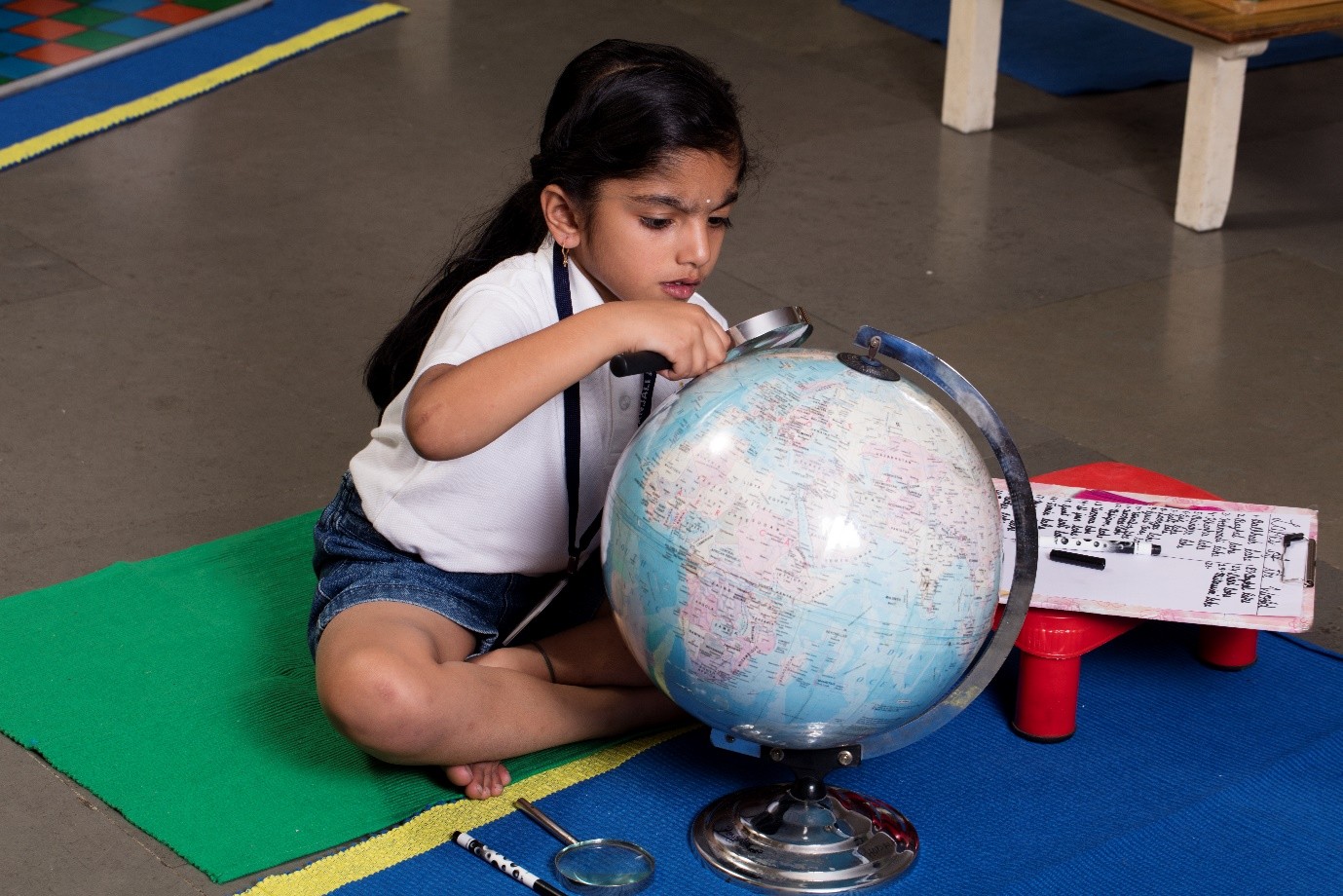
Prepared environment: Montessori
classrooms are well-equipped with interactive materials like bead chains,
wooden blocks, and other materials that encourage children to interact and
learn on their own accord. This practice encourages curiosity and
self-exploration in children.
●
Mixed-age classrooms: Mixed-age
classrooms allow younger children to learn from older students which will
encourage collaboration and mentorship.
●
Independence and self-discipline:
Through self-learning and exploration, children become independent and
disciplined. Children learn essential life skills useful in daily life
activities making them more responsible and self-reliant.
Vidyanjali Academy's Adoption of the Montessori Method
Vidyanjali
Academy has proactively incorporated the Montessori method in its curriculum to
ensure that children develop both academically and holistically. The school
creates an enriching and safe environment, encouraging children to satiate
their curiosity and learn through exploration.
As one of
the only 16 Montessori schools in Bangalore, Vidyanjali Academy takes pride in
its framework to provide its students with a sense of purpose and clarity of
thought, preparing them for the future. The school believes in the core values
of creativity, resilience, independence, critical thinking, and
problem-solving. These skills will not only help create a growth mindset but
will also assist children in their daily life activities.
Vidyanjali
Academy aligns its goals of creating competent and responsible citizens with
the values of Montessori education to provide the best environment and
facilities to all students.
Curriculum Overview
Vidyanjali
Academy follows a structured yet flexible Montessori curriculum that is
tailored to the needs and interests of each student:
●
The education is focused on
stirring and satiating curiosity. Children are taught basic life skills like
cleaning, cooking, and getting dressed which allows them to gain control over
their movements and be able to take care of themselves.
●
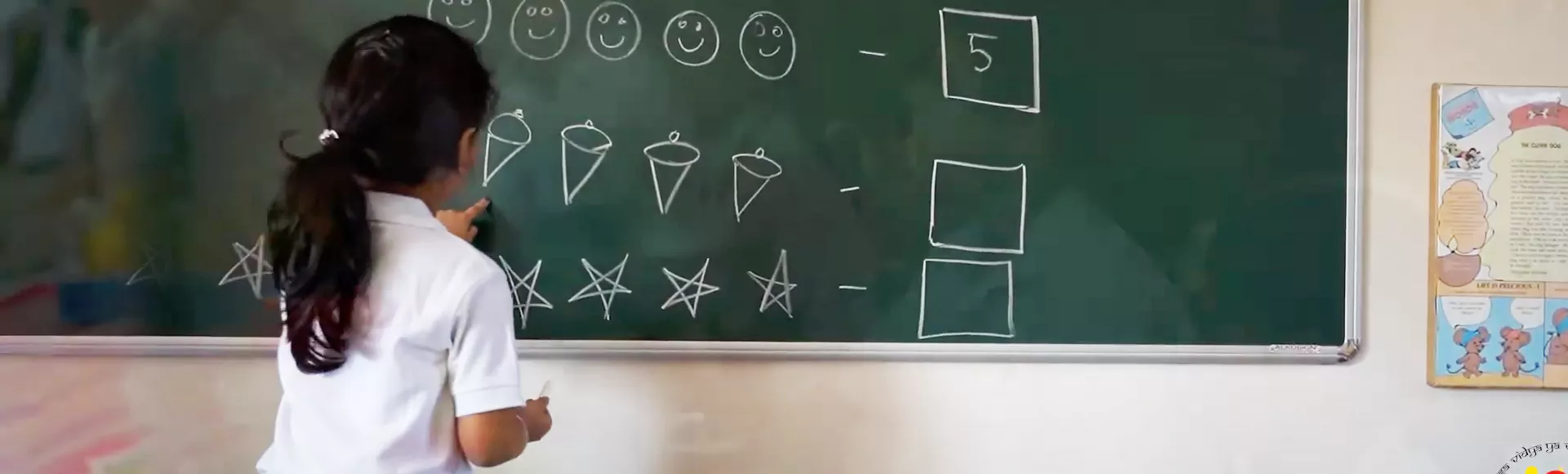
Through sensorial learning,
children are able to fine tune their
senses as tools to learn and become more conscious about the physical
properties of the things around them.
They develop
problem-solving and critical-thinking skills at a young age.
●
Children are introduced to
early concepts of maths, language, and culture to broaden comprehension skills.
●
In this stage, children are
encouraged to take part in group activities to promote social development,
teamwork, leadership skills, and collaboration.
●
The education is focused on
concepts of mathematics, science, language, social science, and cultural
studies, using interactive material to promote a lifelong love for knowledge.
●
The main focus of the primary
program is to promote reasoning, critical thinking, moral awareness, social
skills, and independence through hands-on learning.
Classroom Environment and Materials
The
Montessori classrooms at Vidyanjali Academy are well-equipped and designed
carefully. The structure of our classrooms allows children to move around
freely and interact with various interactive materials like number rods, wooden
blocks, and movable alphabets to promote sensory learning and learning through
exploration.
The
classrooms at Vidyanjali Academy are of mixed-age with students of different
age groups to promote mentorship, leadership, and social interaction. Each
class comprises at most 35 students with two educators who observe and help out
wherever necessary, allowing the students freedom within limits.
Role of Educators
The
educators of the Montessori method at Vidyanjali Academy play a huge role in
the development and growth of the students. The role of the teacher is to
observe the students and provide individual insight based on the learning pace
of the child. It is important that each teacher be patient and respect every student’s
interest and learning pace. Every teacher at Vidyanjali Academy works towards
the holistic development of all students.
Before
being hired as a teacher at Vidyanjali Academy, every teacher goes through a
comprehensive training period with both external and in-house training sessions
to keep them up-to-date with recent developments and get ahead of challenges.
Vidyanjali ensures that its teachers are highly trained in Montessori
education, emphasizing patience, empathy, and adaptability.
Assessment and Progress Tracking
Unlike
the grading system of traditional education, Montessori education focuses on
overall growth and development. At Vidyanjali Academy, development is measured
through portfolios and observations by teachers. Students keep a portfolio
containing all of their work and achievements. Teachers keep a report of the
learning patterns and progress of each student.
These
reports of overall growth are then shared with the parents through
parent-teacher meetings to keep them updated on their child’s developmental
journey.
Benefits of the Montessori Method at Vidyanjali Academy
The
Montessori method has many academic, social, and emotional advantages:
●
Academic: Children who are
Montessori-educated develop literary skills at an early age and have better
comprehension skills than students who are taught using traditional methods.
●
Social: Through the Montessori method,
children develop better communication and conflict resolution through group
discussions and mixed-age classrooms.
●
Emotional: Children are able to develop
emotional intelligence and empathy through social interactions and group
activities.
Success Stories
Both
parents and alumni alike have shared their experiences at Vidyanjali Academy:
Manasa Sharma (Class of 2008)
Manasa,
a Cinematographer and Associate Director, expressed how the curriculum and
infrastructure at Vidyanjali Academy helped her to be creative. Manasa
took part in many co-curricular activities and events that encouraged her to
pursue a career in the entertainment industry.
Roman Vasa
Roman has
a child in grade 3 and another in Pre-primary 1. He expressed that the
institution feels like “a home away from home” for their kids. He was impressed
and touched by how much the teachers knew about each student beyond just their
names.
Extracurricular Activities and Holistic Development
Vidyanjali
Academy goes beyond academic development and makes an effort to add
extracurricular programs into its curriculum:
●
Sports and Physical Education:
Vidyanjali Academy is home to both indoor and outdoor courts (Basketball court,
Badminton, Table Tennis, and Volleyball) where children can develop their motor
skills and teamwork.
●
Arts and Music: Vidyanjali Academy
houses a state-of-the-art art studio and music room where students can unleash
their creativity and self-expression.
●
Community Engagement: Students of
Vidyanjali Academy are encouraged to help out and volunteer at various NGOs,
fostering empathy and responsibility.
Admissions Process
The
enrollment process at Vidyanjali Academy is simple:
Start by filling out the admission form on the website.
After you have submitted the form on the
website, a counselor will get on a call with you to share details with you
about Vidyanjali Academy, the Montessori curriculum, and the admission process.
1. Submit all required documents,
including your child's birth certificate, to the admission office.
2. Visit the campus with an
appointment and observe the environment and methods of teaching at Vidyanjali
Academy.
3. At last, an Interview with the
admission team and school Principal
will be conducted.
Note:
Final meeting with the Principal
does not mean that the admission of the child is confirmed. Admission depends
on various factors like age, readiness for Montessori education, assessment
results, and vacancy.
Montessori
education has changed the way we perceive education. Through the Montessori
method, children can grow, not just academically but in all aspects of life.
The skills developed during this time will help these children in both their
professional and personal lives. Vidyanjali Academy has adopted the philosophy
of Montessori education and works towards shaping students into competent and
responsible citizens with a lifelong love for learning.