
With time, education has evolved. Parents nowadays are actively
looking for the best alternatives to traditional education to allow their
children to grow in academics and personal growth. One of the alternatives is
Montessori education. It is a philosophy that has gained global recognition for
its principles and core values that focus on preparing children for real-life
situations. But what exactly is Montessori education, and why is it relevant
today?
Montessori education is a philosophy that focuses on the personal
growth of a child. It encourages children to grow individually at their own
pace while focusing on core values of independence, hands-on learning, critical
thinking, and problem-solving.
Montessori education in an enriching and prepared environment
encourages children to be self-reliant collaborative and turns them into
responsible human beings that become model citizens of the future. In today’s
world, it is important that children flourish not just academically but in
other areas of personal and social growth.
The Core Philosophy of Montessori Education
Who founded the Montessori method, and why?
The Montessori education system was developed by Dr. Maria
Montessori in the early 20th century. An Italian physician and educator, Maria
believed that education should encourage children to be independent and
resilient. To promote this growth, children should learn in a prepared
environment that promotes free exploration and respects natural psychological
development.
How Montessori Education Prepares Children for Future Success
Montessori education goes beyond just academic excellence. It
focuses on shaping the morals of the students and honing skills that will be
useful to them in their daily lives. The term “future success” in the context
of Montessori means that a child is not just academically developed. It means
that the child is responsible, independent, and resilient, has morals and
values, and is a model citizen, able to differentiate between right and wrong.
In the 21st century, certain skills like independence, critical
thinking, problem-solving, collaboration, empathy, and adaptability are very
important to be able to thrive in the modern world. Montessori education
focuses on that at its core.
Critical Life Skills Nurtured in Montessori Education
Montessori education instills critical life skills in children that
will help them in their lives in the future. These skills are:
● Independence & Self-Motivation:
Children are encouraged to make their own choices and take part in activities
that interest them. Self-learning allows them to learn without boundaries.
● Critical Thinking & Problem-Solving:
Individual activities and teaching through interactive material not only
satiate curiosity but also enhance the children’s critical thinking and
problem-solving skills.
● Time Management & Self-Discipline:
Children can manage their time effectively and learn self-discipline by taking
part in activities and doing daily chores that will help them in the future.
● Collaboration & Teamwork: Group
activities and mixed-age classrooms teach the students cooperation,
communication, and conflict resolution.
● Emotional Intelligence & Empathy:
Interactions with mixed-age children increase social awareness and encourage
empathy among peers.
● Adaptability & Resilience: Children
perform mundane tasks on their own to be self-reliant. Constant trial and error
allow them to be resilient.
How Montessori Fosters Cognitive Development
Montessori classrooms are prepared and create an enriching
environment for the students to learn freely. In this environment, students can
choose activities of their interests, encouraging lifelong love for knowledge
and learning.
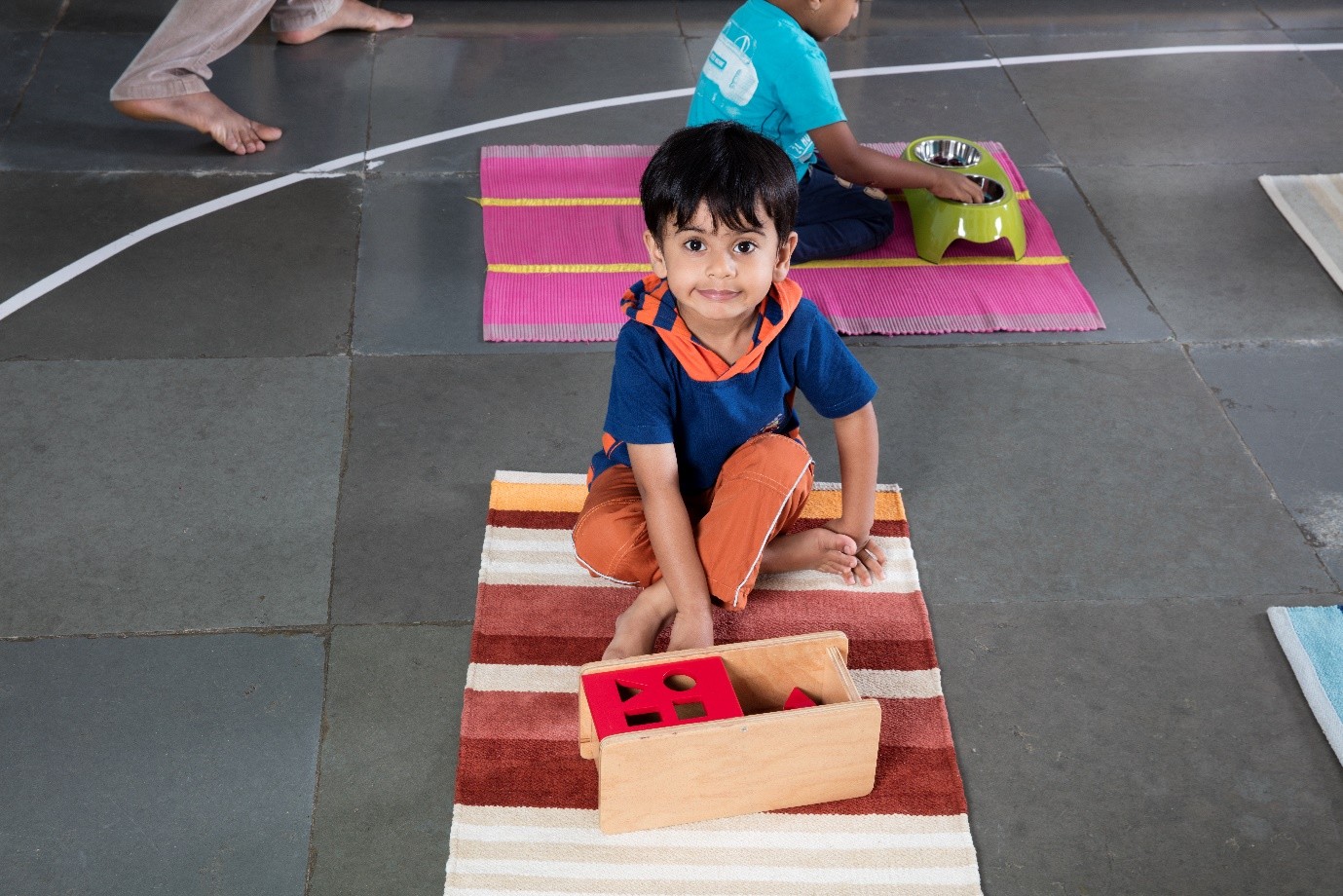
The curiosity of children is satisfied with the help of interactive materials
like wooden blocks and rods. These tools make learning core concepts of
language, math, and science more fun. For example, bead chains are an
exceptional tool for counting, while blocks are great sensorial tools that
increase the flow of creativity.
Studies have proved that Montessori-educated children outperformed fellow peers
in math, science, and language concepts and adapted well to various situations
of self-directed learning. Additionally, research strongly suggests that Montessori students have better critical thinking
and problem-solving skills than students of traditional education.
The Social and Emotional Benefits of Montessori Education
Montessori’s holistic approach extends beyond academics, supporting
social and emotional growth:
● Social Development: Students learn and
communicate freely with their peers allowing them to develop social awareness
and cooperation.
● Mixed-Age Classrooms: Mixed-age
classrooms allow younger children to learn from older children, while older
students can reinforce their knowledge by teaching.
● Conflict Resolution: Since children
interact freely with those around them, they learn conflict resolution and
develop empathy.
● Growth Mindset: Constant trial and error
encourage students to be resilient and responsible, increasing emotional
intelligence and responsibility.
Montessori and Technological Literacy
Montessori education takes great effort to combine both exploration
and digital learning:
● Balanced Approach: Montessori education
takes great steps to include screen-based learning in the curriculum while
balancing it with real-life experiences and activities.
● Digital Preparedness: Digital classrooms
allow exposure to technology in a way that makes learning enjoyable yet
impactful.
● Healthy Screen Time Limits: Montessori
education makes sure that the screen time is limited, allowing the children to
also take part in other activities and promotes hands-on learning through
exploration and interaction.
Montessori Education for Special Needs and Diverse Learners
One of the core principles is that Montessori education allows each
child to work at their own pace, adapting to children with different learning
styles. Montessori education allows a teacher to observe each child’s learning
patterns and where they are having difficulties.
Some learning disabilities, unlike dyslexia, autism, and ADHD, can
be corrected if diagnosed in the early stages. One of the most significant
strengths of Montessori education is its adaptability to various learning
styles. It has proven effective for neurodivergent children.
Several success stories by parents and students have shown that
children can focus on self-directed learning in Montessori settings. Children
with autism spectrum disorder have made significant progress in communication
and social interaction, and dyslexic children have improved their reading
skills using interactive materials.
Comparison of Montessori Education vs. Traditional Education
While traditional education focuses on discipline and order, where a
teacher instructs the students, Montessori education focuses on self-learning
through exploration, where teachers act as guides.
Traditional education has a rigid and standardized curriculum
focused on assignments, exams, and books, whereas Montessori education is
flexible, personalized, and allows individual learning and growth.
Unlike traditional education, which focuses on grades and marks,
Montessori education goes beyond that and focuses on the overall growth of the
child in all aspects.
Montessori education encourages children to make their own choices and choose topics of their interests, allowing them to be responsible and independent. It promotes skills that will not only help children in their careers but also be useful in their daily lives.
Montessori Education at Different Stages
Montessori education is taught at different levels according to age
groups and their developmental stages:
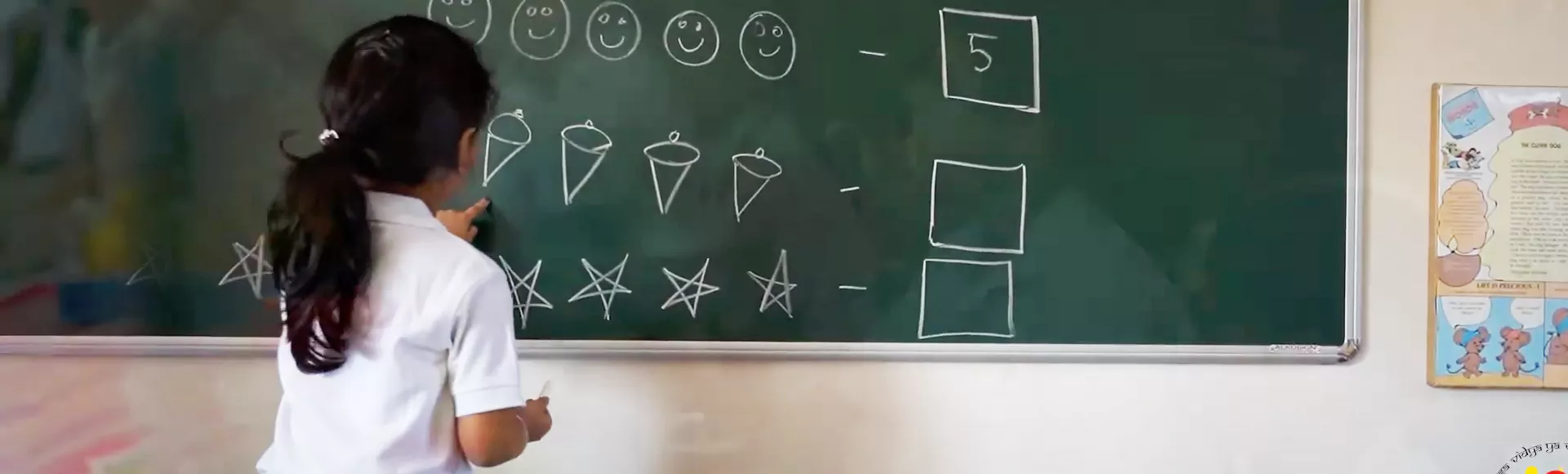
● Early Childhood (3-6 years):
Introduction to basic early concepts of maths, science, and language. The
children are taught through hands-on learning, open-ended activities, and
interactive materials.
● Elementary (6-12 years): In-depth
studies of core subjects to develop comprehension skills and satisfy curiosity.
● Adolescents (12-18 years):
Problem-solving, critical thinking, and self-directed projects to promote
independence and resilience through trial and error in a real-world setting.
Evidence-Based Outcomes: Research & Studies
Studies and research conducted over time prove that
Montessori-educated children experience better overall growth than their peers
who have studied in a traditional setting.
A study on the impact of Montessori practices in
early childhood education was conducted in 2021. The results showed that
children from Montessori schools had better reading skills and vocabulary and
developed literary skills earlier than children studying in a traditional
setting.
Another study, conducted in 2024, compared
Montessori and traditional education approaches in primary schools. The results
clearly showed that Montessori-educated students had better cognitive
development and social growth. Children from Montessori schools also had a
better grasp of concepts of science, mathematics, and language.
These studies suggest that Montessori education allows children to
grow more academically and personally than their traditionally educated peers.
Testimonials and Case Studies
Testimonials from students who have studied in a Montessori setting
go to show the impact of its principles:
Shilpa (Vidyanjali Academy - Class of 2006)
Shilpa, an HR professional at Accenture, describes how Montessori education contributed greatly to her development and growth. Shilpa felt that the hands-on learning, self-direction, and independence allowed him to hone her leadership and communication skills, which helped her face challenges in her career.
Mansa Sharma (Vidyanjali academy - Class of 2003)
Mansa, a Cinematographer and Associate Director, expressed how the
curriculum of Montessori education at Vidyanjali Academy helped her to be
openly creative. After taking part in many co-curricular activities as part of
the Montessori education approach, Mansa was able to find her interest and was
able to pursue a career in the entertainment industry.
Parents and educators alike have also sung their praises of the
Montessori education system, saying that its approaches and focus on
self-direction have had a deep impact on the students. Parents have noticed
increased confidence, communication, and curiosity in their children, whereas
educators have shared that students have shown engagement, conflict resolution,
and self-discipline.
The Role of Parents in Montessori Education
Parents play a huge role in Montessori education. At home, it is
important that parents reinforce the ideologies and practices taught at school.
Parents can play their part by encouraging their children to perform simple
tasks like cooking, cleaning, and self-care under guidance to promote
independence and responsibility.
It is important that parents choose the right school for their
children to study in a Montessori setting. Some factors that parents must
consider while choosing the right Montessori school are a prepared and
enriching environment, trained educators, safety, and good infrastructure.
Montessori education is a transformative approach to education that
goes beyond academics. It encourages students to hone essential life skills
that will assist them in their daily life activities. Vidyanjali Academy for
Learning is an institution dedicated to the Montessori growth mindset, seeking
overall growth for students. Vidyanjali Academy for Learning uses Montessori
approaches to shape students into model citizens with values and morals.