

At
Vidyanjali Academy, the Montessori method is part of everyday life. It helps
children grow with independence, curiosity, and a love for learning that stays
with them. The school started in 1992 under the Sri Ramaiah Reddy Educational
Trust and has 33 years of experience in
helping children learn in a thoughtful and balanced way.
From
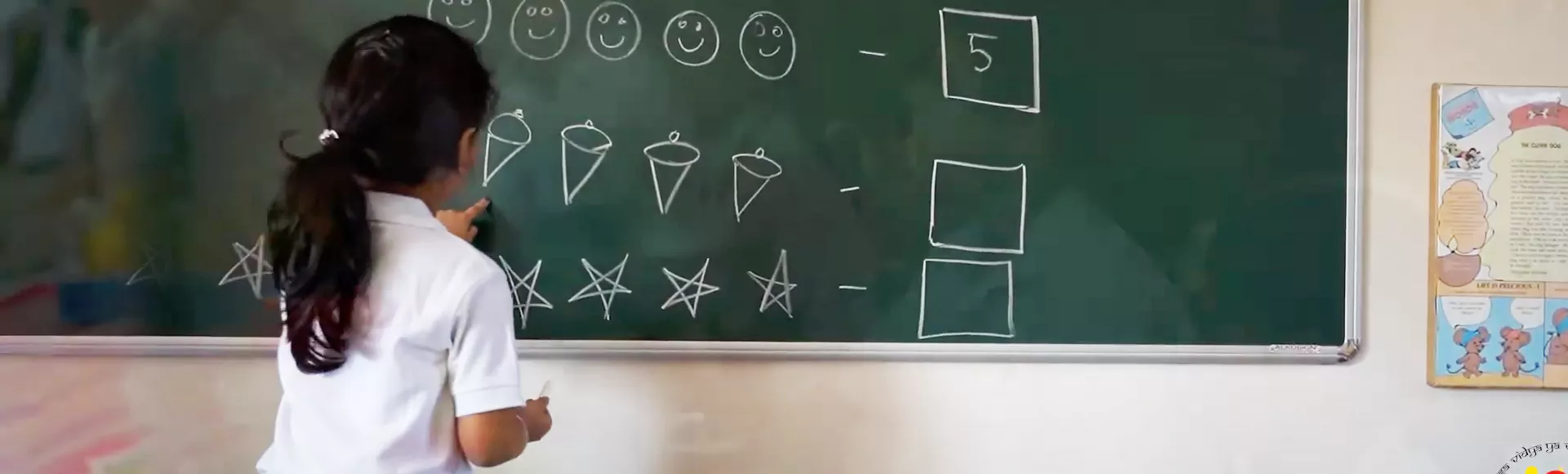
day one, children are seen as capable. The classrooms are set up so they can
explore, try things out, and learn by doing. Materials are easy to use and made
to support learning through hands-on activities. Instead of being told what to
do all the time, children pick their work, go at their own pace, and slowly
build confidence and focus.
So
what’s in this post for you? You’ll see the core ideas behind how Montessori
works at Vidyanjali Academy. And more importantly, how these ideas can support
your child’s development, creativity, and sense of community. Let’s walk
through them one by one.
What Is Montessori Education?
Developed
by Dr. Maria Montessori in early 1900s Italy, the Montessori method is a
child-centered approach to education rooted in observation, independence, and
respect for a child’s natural development. At Vidyanjali Academy, these
principles guide every aspect of learning, from the classroom layout to the way
students interact with teachers and each other. The goal is holistic
development, physical, emotional, social, and cognitive, through active,
self-directed learning.
Respect for the Child
Montessori
education begins with the belief that children are naturally curious and
capable. At Vidyanjali, respect means trusting the child’s ability to explore,
make choices, and take responsibility for their learning. This nurtures
discipline from within, rather than through external control.
The Absorbent Mind
Dr.
Montessori described the young child’s brain as an "absorbent mind",
soaking up everything from the environment effortlessly. Vidyanjali’s
classrooms are built to support this phase, offering sensory-rich, hands-on
materials that align with how young brains learn best.
Sensitive Periods
From
birth to age six, children pass through "sensitive periods" for
learning key skills like language, order, movement, and social behavior. At
Vidyanjali, materials and activities are introduced at just the right time to
match these windows, so children learn when they’re most ready.
The Prepared Environment
Learning
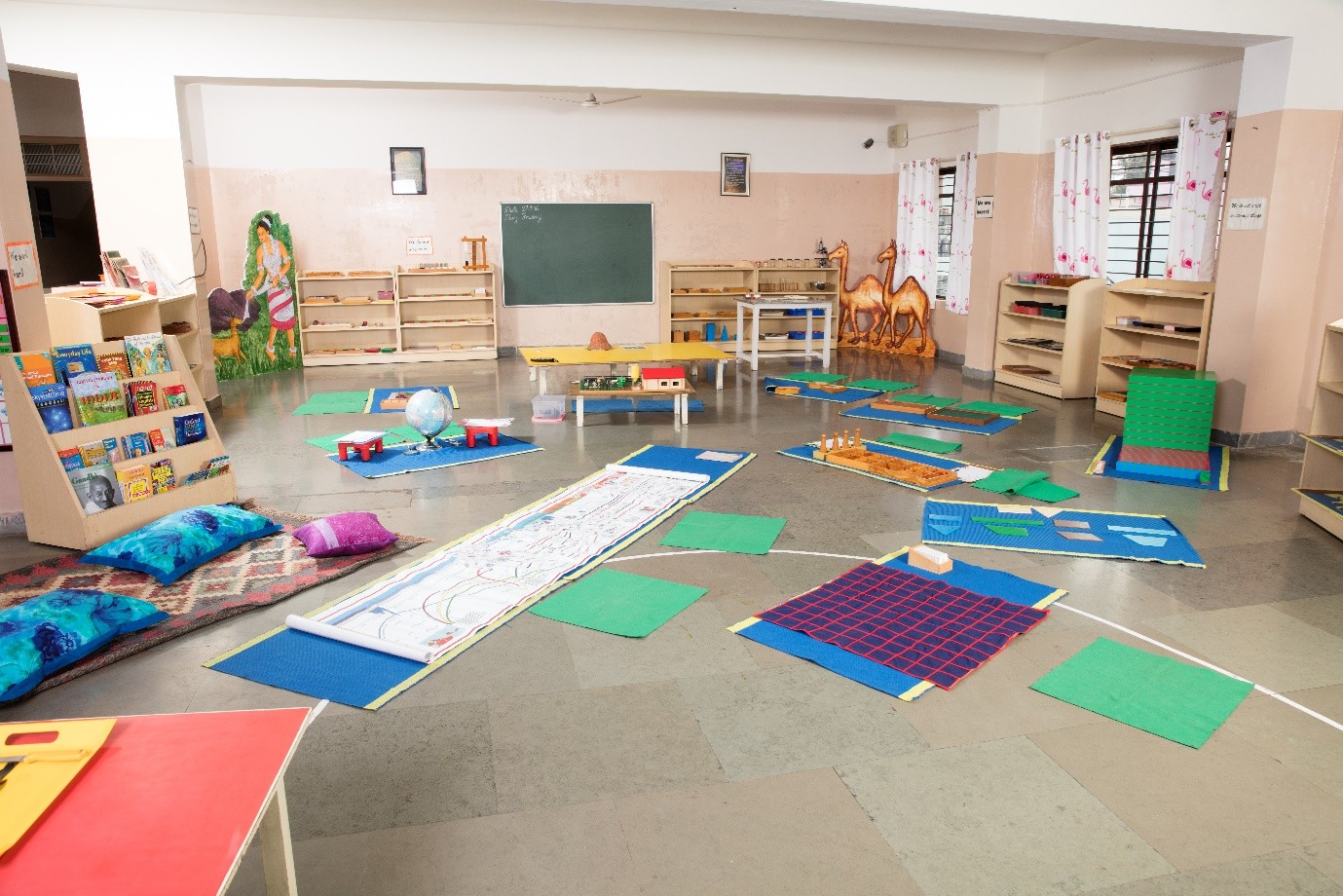
spaces at Vidyanjali are calm, beautifully organized, and fully accessible to
the child. From child-sized furniture to open shelves with carefully selected
materials, every detail invites independent exploration and focused work.
Auto-Education (Self-Learning)
Montessori
believed children educate themselves when given the right tools. At Vidyanjali,
students work with materials that are self-correcting and open-ended, allowing
them to solve problems, experiment, and repeat until mastery, without needing
constant instruction.
Freedom Within Limits
Children
enjoy meaningful freedom, like choosing their activity or working alone or in a
group, but within clear boundaries. This structure at Vidyanjali helps them
develop self-discipline, decision-making, and respect for others.
Teachers
at Vidyanjali are not traditional instructors. They act as guides, observing
quietly, stepping in only when needed, and offering individualized support.
Their focus is to match the child’s readiness with the right material, not to
impose lessons on a rigid timeline.
What Makes a Montessori Classroom Unique?
Montessori
classrooms are purposefully designed to support deep focus, independence, and
meaningful learning. At Vidyanjali Academy, every element, from the materials
to the schedule, is aligned with the child’s natural developmental path.
1.
Montessori Materials and Hands-On
Learning
Children
don’t just hear concepts, they experience them. Materials like the Pink Tower,
Golden Beads, and Moveable Alphabet give abstract ideas a physical form. These
tools are not just for play; each one has a direct aim (e.g., building math or
language skills) and an indirect aim (like developing order, coordination, or
logical thinking). Sensorial and manipulative materials help children engage
through touch, movement, and self-correction, laying a solid foundation for
abstract reasoning.
2.
Mixed-Age Classrooms and Peer
Learning
Instead
of grouping students by a single age, Montessori classrooms include a
three-year age range. This mirrors real-world social dynamics and allows
younger children to learn by observing older peers. In turn, older students
deepen their understanding by mentoring others. The result is a stable,
respectful environment where emotional growth and leadership develop naturally
over the full three-year cycle.
3.
Uninterrupted Work Periods and
Deep Focus
Students
at Vidyanjali enjoy extended work periods, typically lasting 2–3 hours without
scheduled interruptions. This encourages sustained concentration, exploration,
and mastery. During this time, the teacher doesn’t lead from the front, they
observe, guide, and step in only when needed. The classroom becomes a space
where children enter a state of flow, fully engaged in their chosen tasks.
4.
Montessori vs Traditional
Education: A Different Path to Success
Montessori
education emphasizes independence, curiosity, and process-driven learning,
where children choose tasks, work at their own pace, and self-assess progress.
Traditional models often focus on teacher-led instruction and external grades.
Studies show Montessori learners demonstrate strong academic outcomes, along
with greater emotional regulation, social awareness, and adaptability, benefits
that carry well into adulthood.
Is the Montessori Approach Right for Your Child?
Choosing
Montessori is not just about picking a school; it’s about aligning with a
philosophy of learning. To know whether it’s the right fit for your child and
your family, it’s important to look beyond the method and understand the
mindset behind it.
What Kind of Children Thrive in Montessori?
Montessori
works well for kids who like to explore things on their own. If your child is
naturally curious, independent, or enjoys hands-on learning, they may feel
right at home. These children often like making their own choices and going
deep into topics they enjoy.
But that
doesn’t mean Montessori isn’t for others. Children who are shy, energetic, or
need more structure can also do well, especially when they get steady support
from teachers and parents.
In the
end, what matters most is how the Montessori approach is used in the classroom.
It’s less about the child’s personality and more about how the learning
environment is set up and followed through.
Common Misconceptions and Real Challenges
A lot of
parents think Montessori means kids can do whatever they want or that it
doesn’t focus on academics. But that’s not true. Montessori classrooms are set
up with care. Kids learn through independence, not chaos.
Everything
has a purpose. Materials are arranged in a way that helps learning build step
by step. The rules are clear. The progress is real, even if it doesn’t always
look like the standard report card milestones.
Problems
usually come up when parents and schools expect different things. If you’re
hoping for quick results or using a different approach at home, it can feel
like Montessori isn’t working. But when you don’t fully understand the method,
it’s easy to confuse its calm, personal pace with “no progress.”
Age-Appropriate Fit: Infant to Elementary
Montessori
is not a one-size-fits-all model, it adapts to the needs of each age group:
●
Infants and Toddlers (0–3): The focus is
on freedom of movement, sensory exploration, and trust-building with adults.
●
Primary (3–6 years): Children develop
independence, concentration, and early academic skills through hands-on
materials.
●
Elementary (6+): Students explore
abstract thinking, social collaboration, and big-picture learning through
integrated subjects.
Montessori
works well when home and school follow the same values. That’s why parent
involvement isn’t just a bonus, it’s a must. At Vidyanjali Academy, for
example, parents take part in workshops and regular communication. This helps
them understand how Montessori works and why it’s effective.
You also need to make sure the school follows real Montessori practices. Check for signs like trained teachers, mixed-age classrooms, self-correcting materials, and long work periods without breaks. If the school is accredited or linked with a known Montessori group, that’s a good sign too.
What age is Montessori education best for?
Montessori
works exceptionally well from birth through the elementary years, with programs
tailored to each developmental stage. The most well-known and impactful phase
is the 3–6 age group, where foundational habits of independence, focus, and
social interaction are built.
Can Montessori work at home?
Yes,
Montessori principles can be applied at home, through child-sized furniture,
limited choices, and routines that support independence. However, replicating a
full Montessori classroom requires training, so home efforts are best seen as
complementary rather than a substitute.
Is Montessori only for preschool?
No,
Montessori goes beyond preschool. While it’s most popular for ages 3–6, many
Montessori schools, like Vidyanjali Academy, offer programs for lower elementary
grades, each designed around the child’s developmental needs.
How is progress assessed in Montessori classrooms?
Progress
is tracked through detailed teacher observations and learning portfolios, not
grades or tests. Montessori educators monitor how children interact with
materials, solve problems, and gain mastery over time, focusing on depth, not
speed.
Are Montessori students behind or ahead academically?
Montessori
students often meet or exceed academic benchmarks, especially in reading, math,
and executive function. The timeline may look different early on, but the deep
understanding and confidence they build tend to give them an advantage
long-term.
Is Montessori good for children with learning differences?
Montessori
can be highly supportive for children with learning differences due to its
individualized pace, multi-sensory materials, and low-distraction environment.
However, success depends on the training of the educators and how well the
program accommodates specific needs.
How expensive is Montessori education?
Montessori
programs may be more expensive than traditional schools due to specialized
materials, lower student-teacher ratios, and trained staff. However, many
parents find the long-term developmental benefits well worth the investment.
Is it too unstructured for some children?
While it may appear unstructured, Montessori classrooms follow a very intentional structure, one that empowers the child. Some children may need time to adjust, but with guidance, most thrive in the freedom-within-limits approach.