

When you
step into the Montessori classrooms at Vidyanjali Academy for Learning, the
first thing you notice is that it doesn’t look like a “typical” classroom.
There are no rows of desks facing a blackboard. Instead, you see low shelves,
neatly arranged wooden materials, soft floor mats and children quietly choosing
work on their own.
Every
tray, every bead, every cylinder has a purpose. Montessori materials are not
random teaching aids; they are carefully designed tools that help children move
from hands-on exploration to deep understanding. At Vidyanjali, these materials
form the heart of the pre-primary and early-primary experience, guiding
children from age 2.5 onwards through practical life, sensorial, language, math
and cultural learning in a calm, ordered environment.
This page
gives you a parent-friendly overview of the key Montessori materials you’ll see
at Vidyanjali, what they are used for, and how they support your child’s
development across different age groups.
What are Montessori materials used for?
Montessori
materials are the hands-on learning tools that children work with every
day in the classroom. They are designed to:
●
Isolate one concept at a time,
such as size, weight, sound, letter sound, quantity or place value
●
Allow the child to repeat
an activity independently until the concept becomes clear
●
Offer built-in “control of
error,” so children can see and correct their own mistakes without constant
adult correction
At
Vidyanjali, these materials are central to how children learn from the
pre-primary Montessori stage all the way into the lower primary years, where
Montessori methods are blended with CBSE expectations.
The philosophy behind Montessori materials
Montessori
education is based on the belief that young children learn best through self-directed
activity and hands-on exploration. Materials are therefore designed
to:
●
Respect the child’s natural
curiosity and “absorbent mind”
●
Match specific sensitive
periods (for language, order, movement, refinement of senses, etc.)
●
Help children move from
concrete experiences to abstract thinking at their own pace
Vidyanjali’s
Primary Montessori: recognition from the Indian Montessori Centre (IMC).
Primary: recognized by the Indian Montessori Association (IMA), which means the
materials and classroom design follow authentic Montessori principles rather
than just using a few “inspired” ideas.
Main categories of Montessori materials at Vidyanjali
Practical
life materials are usually the first things a young child works with in
Montessori. At Vidyanjali, you’ll see:
●
Pouring and transferring
activities: small jugs, spoons, bowls and trays for
pouring water, transferring grains or beads, and later using tongs or tweezers.
●
Dressing frames and
self-care activities: frames with buttons, zips,
buckles, bows, as well as child-sized tools for hand-washing, table-wiping,
plant care and tidying.
Sensorial materials, refining the senses
Sensorial
materials help children classify and organise the world using their
senses. In Vidyanjali’s Montessori rooms, you’ll see classic equipment such as:
●
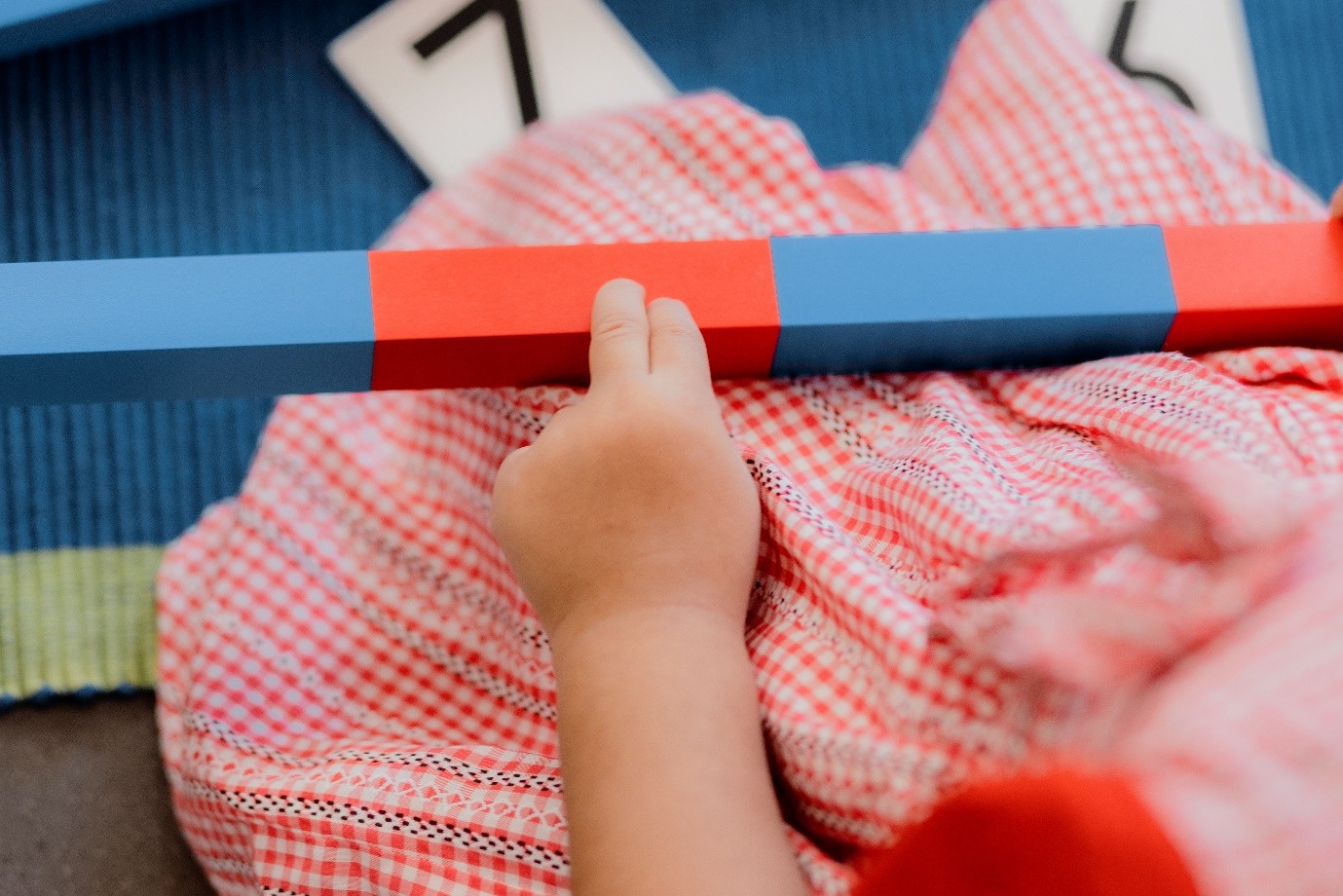
Graded towers and prisms (like
the well-known Pink Tower and Brown Stair) to explore size and dimension
●
Rods and cylinders that vary in
length, thickness, weight or volume
●
Colour tablets, sound boxes and
texture boards that isolate colour, pitch or touch
Vidyanjali’s
own blog on Montessori materials highlights how sensorial tools focus on touch
and sound, while maths and language items build early reading and counting
skills, all of which you can see in action when children are quietly absorbed
on their mats.
Language materials, from sounds to sentences
Language
development in Montessori starts long before formal reading.
Vidyanjali’s Montessori classrooms use a range of language materials to move
children step by step:
●
Sound games and oral
language activities to build rich vocabulary and
phonemic awareness
●
Sandpaper letters so children can trace letter shapes while hearing the sound,
linking touch, sight and hearing
●
Moveable alphabets that let children build words and sentences on mats even before
they can write with a pencil
Cultural and science materials, opening up the world
Montessori
doesn’t stop at language and maths. Cultural and science materials in
Vidyanjali’s Montessori classrooms introduce children to:
●
Geography: puzzle maps of continents, countries and landforms
●
Biology: puzzles and charts of plants, animals and human body parts
●
Science and the environment: simple experiments, classification cards and nature-based
activities
These
materials help children connect what they see in their surroundings with
organised knowledge, building early interest in science, geography, and
environmental awareness, something Vidyanjali reinforces further through
outdoor experiences like tree walks and nature-focused outings for Montessori
students.
When should you introduce Montessori materials by age?
At
Vidyanjali, Montessori is not a one-year “method”; it’s a progressive
experience that unfolds from around age 2.5 through the early primary
classes.
Ages 2.5–3: Settling and early practical life
In the
youngest Montessori groups, the focus is on:
●
Simple practical life work:
pouring, spooning, opening and closing, carrying, rolling mats
●
Early sensorial exposure:
large, obvious differences in size, shape, and colour
●
Grace and courtesy lessons: how
to greet, wait, say “please” and “thank you,” and move respectfully in the
environment
Materials
are chosen to be very concrete and satisfying, helping toddlers build
trust in themselves and in the classroom routine.
Ages 3–6: Casa / Primary Montessori
This is
the classic 3–6 Montessori cycle, which Vidyanjali follows in its
pre-primary wing:
●
Practical life expands into
more complex sequences (e.g., multi-step food preparation, polishing, and
advanced dressing frames).
●
Sensorial materials become more
refined, helping children compare subtle differences and build internal order.
●
Language materials move from
sounds to letters, then words, phrases, and early reading.
●
Maths materials introduce
number symbols, quantities, operations, and the decimal system in a hands-on
way.
●
Cultural and science work
becomes richer, with maps, nature studies, and simple experiments.
By the
end of this phase, many children are reading, writing, and working with numbers
with confidence, but just as importantly, they have learned how to choose work,
finish tasks, and respect others’ space and materials.
Ages 6–9: Lower elementary and beyond
Vidyanjali
extends the Montessori way of teaching into the classes Montessori Lower Elemantary, blending
it with CBSE requirements up to around Class 3 as highlighted in parent reviews
and external descriptions.
In these
years, materials:
●
Become more abstract and
research-oriented, charts, timelines, experiments, and project materials
●
Support collaborative work,
where small groups explore topics together using concrete references
●
Bridge Montessori understands
with CBSE textbooks and assessments, so children can handle both hands-on
projects and written work comfortably
The
overall aim is to keep the spirit of Montessori alive, curiosity,
independence and respect, even as academic expectations rise.
How do Montessori materials support child development?
Dr Maria
Montessori described the young child’s mind as an “absorbent mind”,
naturally taking in impressions from the environment. She also identified sensitive
periods when children are especially drawn to specific kinds of learning
(language, order, movement, etc.).
Vidyanjali’s
Montessori materials and classroom routines are arranged to meet children
exactly at these moments:
●
Orderly shelves, consistent
layouts and clear sequences appeal to the child’s love of order.
●
Language and maths materials
are introduced when children show readiness, not by age alone, making learning
feel joyful rather than forced.
●
Movement-based activities and
floor work satisfy the need to move while still working with purpose.
Encouraging independence and motivation
Because
Montessori materials have built-in control of error and are accessible on open
shelves, children at Vidyanjali can:
●
Choose their own work within
clear limits
●
Repeat activities as many times
as they like
●
Correct their own mistakes
without embarrassment
This
builds intrinsic motivation, children work because they are interested,
not just because an adult is watching. Parents often notice this carry over at
home, where children begin to take more responsibility for small tasks and show
pride in doing things “by myself.”
Building focus, concentration and problem-solving
If you
observe a Montessori class at Vidyanjali, you’ll see children deeply focused on
arranging beads, matching shapes or constructing towers. This concentration is
not an accident; the materials are intentionally:
●
Just challenging enough to be
interesting
●
Clear enough that children can
see when something is “not quite right” and try again
●
Open to extensions, once a
child has mastered the basic activity, the teacher can show new variations that
stretch their thinking
Over
time, this kind of work strengthens attention span, patience and
problem-solving, qualities that support success in any later learning
environment, including Vidyanjali’s CBSE primary and middle school sections.
Montessori materials at school and at home
The
detailed, didactic materials you see at Vidyanjali are carefully chosen,
maintained and rotated by trained Montessori staff. Parents often ask how they
can support this approach at home as well.
Where do authentic Montessori materials come from?
Vidyanjali
uses classic Montessori didactic materials across Practical Life, Sensorial,
Language, Math, and Cultural areas, and quality guidelines set by international
Montessori bodies. This ensures that each piece functions exactly as it was
designed to.
For home
use, Vidyanjali encourages parents to focus less on replicating every material
and more on:
●
Creating simple, ordered spaces
●
Offering a few well-chosen
activities at a time
●
Allowing the child time and
freedom to repeat
Parents
can always speak to Vidyanjali’s Montessori teachers for suggestions if they
are considering specific purchases.
Montessori-aligned vs Montessori-inspired products
In
today’s market, you’ll find many toys labeled “Montessori inspired.”
Vidyanjali’s own posts clarify that Montessori equipment is not the same as
generic teaching aids, it is didactic material, meaning it is designed to
teach a specific concept with built-in control of error.
A
material is more likely to be Montessori-aligned when it:
●
Focuses on one clear concept at
a time
●
Uses real, natural materials
where possible (wood, metal, fabric)
●
Encourages active doing and
repetition, not passive watching
●
Has a clear way for the child
to see and correct mistakes independently
Are Montessori materials suitable for home, and are they worth it?
For most
families, the full, authentic set of Montessori materials is best experienced
in school, in Vidyanjali’s case, within a thoughtfully prepared environment led
by trained teachers.
At home,
a small selection of well-chosen activities, plus everyday practical life
tasks, is usually enough. The real “investment” is not only in objects but in a
Montessori way of relating to the child, with respect, patience and trust in
their capabilities.
That said, when your child spends their days in a rich Montessori environment like Vidyanjali’s, many parents feel that the approach itself is more than worth the cost of schooling, because it shapes how children think, behave and feel about learning long after they leave the classroom.