



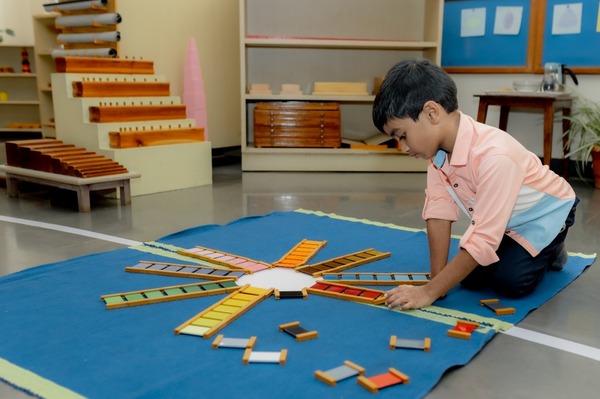
Montessori
education is an approach to learning, that values a child's
natural development. It encourages independence, freedom within limits, and
respect for a child’s natural, psychological, physical
and social growth. Founded on the principles established by Dr. Maria
Montessori, this method emphasizes child-centered learning in a
prepared environment.
At
Vidyanjali Academy for Learning, the Montessori approach is central to early
childhood education. The academy is dedicated to nurturing young minds by
offering a supportive and enriching environment where children can thrive.
A
nurturing environment forms the base of the early childhood curriculum.
Children will ultimately grow best in an environment that tends to provide care
and assistance not only in academic development but also in emotional, social
and physical development. Read on to learn more about how Vidyanjali Academy
for Learning maintains nurturing for children during their Montessori
education.
What is a Nurturing Environment in Montessori Education?
A
nurturing environment includes safety, trust, emotional support and respect. To
the Montessori educator, this means creating an atmosphere in which, children are free to explore, make choices, and learn at their own
pace. The classrooms are designed to develop curiosity and independence.
The
principles of Montessori education, such as freedom within limits, respect for
the child and self-directed learning, form a basis for a nurturing environment.
In this context, nurturing encompasses not only providing care but also guiding
the child in discovering their world and mastering skills that will be useful
in their lifetime development.
How Nurturing Environment Supports Child Development?
Children
need a nurturing environment for their holistic development. It nourishes their
cognitive, emotional, social, and physical growth. The key areas where a
nurturing environment helps students flourish are discussed as follows:
Cognitive Development
Practical
activities in a Montessori classroom enable hands-on experiences with materials
that support critical thinking, problem-solving and creativity. Vidyanjali
Academy for Learning teaches children to establish a true love for learning,
which is different from mere memorization. It helps children ask questions,
investigate and form an independent perception of the concept. Students
learning shifts from abstract concepts to concrete understanding, which gets
retained in their long-term memory.
Emotional Well Being
A
nurturing environment encourages the expression of emotions and teaches
children how to manage their problems constructively. Vidyanjali Academy for
Learning provides an emotionally supportive space to give children safety to
try new things and not fear failure. The teachers guide the children but
provide them with enough space to grow psychologically, which cultivates
resilience and confidence.
Social Skills
A
Montessori school's environment includes social experiences. In such caring
surroundings, children learn how to share, be cooperative and respect each
other. Vidyanjali Academy for Learning has
started the VAL Talks and Rhetorics Gavel club for Public Speaking, which
encourages students to process and share their thoughts systematically and
socialize with peers. Peer contact also enhances mentoring and leadership
skills among children.
Physical Development
Even
physical activity has a significant role in children's development. Vidyanjali
Academy provides indoor and outdoor space for fine and gross motor skills. We
also have different clubs for students to play sports, practice Yoga and
dance. For younger children, many
lessons are planned to be conducted in the playground, where, each
student participates in certain physical activities. This eventually
contributes to the child's physical development.
Why is a Nurturing Environment Crucial in the Montessori Method?
One
of the most important elements of Montessori teaching is a prepared
environment, where classrooms are well organized, warm, and full of materials
for different stages of development. The framework gives children maximum
independence to choose what they wish to and
helps them develop the responsibility and self-discipline necessary for such
freedom. Classes at Vidyanjali Academy for Learning are well-equipped with
Montessori materials for learning by discovery and exploration.
Connection Between Nurturing And Independent Learning
In
Montessori education, nurturing is closely linked with promoting independence.
Thus, children are allowed to choose their activities, which helps them gain
independence and confidence in learning. Vidyanjali Academy gives high value to
the relationship between a nurturing environment and independent learning,
which empowers learners to take responsibility for their education. This not
only improves their academic performance but, also instills
a sense of responsibility and self-motivation in them.
What Are the Key Elements of a Nurturing Montessori Environment at Vidyanjali Academy?
A
Montessori environment is created by scientifically compiling all the key
elements that nurture children. In such
an environment, children learn to explore, experiment, and experience
everything on their own, with a little support from their teachers. Some of
such key elements are as follows:
Classroom Design and Materials
The
Montessori classroom at Vidyanjali Academy for Learning has been thoughtfully
designed. The materials are age-appropriate, hands-on, and available for
children to choose and work on independently. Practical life exercises and Sensorial
materials aid in developing fine motor skills, concentration, and
problem-solving abilities. Children can choose their activities to learn at a
comfortable pace and have the freedom to ask questions.
Teacher-Student Interactions
Teachers
at Vidyanjali Academy for Learning
provide an excellent nurturing environment. They are the mentors,
guiding the children, carefully observing each one to extend their support when
needed. The respect and trust built by teacher-student interactions also ensure
that each child is valued and cared for.
Emotional Safety and Encouragement
A
nurturing environment is based fundamentally on emotional safety. Vidyanjali
Academy for Learning creates an environment in which the child feels
emotionally safe to raise their voice, ask questions, and take risks in
learning. The teachers constantly encourage students, which helps them build
confidence and become resilient.
Inclusivity and Respect for Individuality
Vidyanjali
Academy advocates for respecting individuality and inclusion in all its
endeavors. The Montessori system knows that children learn and understand at
different rates. Vidyanjali's nurturing care environment ensures respect for
every child's unique learning style and pace. We maintain this by providing
special assistance to those in need, especially through personalized assistance
with learning aids.
How Does Vidyanjali Academy Ensure a Nurturing Environment?
Vidyanjali
Academy has clear policies in place to ensure that the environment remains
nurturing for all students. These policies emphasize respect, emotional safety,
and holistic development. The Academy’s
practices are regularly reviewed and updated to meet the evolving needs of its
students.
Qualifications and Training of Teachers
Teachers
at Vidyanjali Academy are trained in the Montessori method and child
development. We ensure that teachers prepare and maintain an environment
conducive to nurturing learning. Periodically, our teachers also attend
professional development programs on the latest educational approaches.
Parent Involvement and Community
Parents
participate in creating a caring environment. Vidyanjali Academy conducts
normal Parent-Teacher meetings, workshops, a Parent Empowerment Day, and all
other forms of open communication to ensure the smooth progress of children.
This collaboration ensures that the children receive consistent support both at
school and at home.
Continuous Improvement and Feedback Mechanisms
Vidyanjali
Academy strongly emphasizes continuous improvement. Feedback from parents,
teachers, and students is sought regularly to identify areas for improvement.
Continuous evaluation helps maintain and enhance the nurturing environment over
time.
What Are the Benefits of a Nurturing Environment for Montessori Students?
A
friendly environment helps children perform well academically because they
start to love learning. Holistically developed and motivated kids in terms of
education are more likely to foster a passion for lifelong learning. At
Vidyanjali Academy, besides good academic performance, students learn how to develop
lifelong critical thinking.
Emotional Resilience and Confidence
A
nurturing environment is fundamentally an atmosphere of emotional safety.
Psychological resilience and self-confidence also naturally blossom in such an
environment. Children who experience emotional safety are able to take on more
challenging tasks, take risks, and learn from their mistakes. This kind of
resilience is crucial not just for success in school, but for
overall well-being of a personality, in general.
Social Harmony and Teamwork
Vidyanjali
Academy encourages social cohesion and teamwork through different activities
and clubs. We provide an environment where children learn to cooperate, respect
diversity, and seek to obtain common results for the benefit of all. We also
follow the Positive Behavioral Interventions and Supports (PBIS) system, which
emphasizes respect, responsibility, and safety.
How Does a Nurturing Environment Influence the Transition to Higher Education?
A
nurturing Montessori environment prepares the child for a smooth transition to
mainstream schooling. Vidyanjali Academy empowers the child with foundational
academic and social skills that will allow them to succeed in later stages of
education.
Transition from Montessori towards Regular Curriculum
The
skills developed in the Montessori environment, such as self-directed learning
and critical thinking, prepare students for the academic demands of traditional
education. This gradual shift ensures they adapt easily to structured classroom
settings while maintaining confidence and curiosity.
Success Stories by Ex-Students of Vidyanjali Academy
Many
of Vidyanjali Academy's ex-students have achieved great results in academic and
personal fields. For many, the warmth prevailing in Vidyanjali provided a
platform for them to gain the energy and confidence to succeed in their lives
ahead.
How Can Parents Support a Nurturing Environment at Home?
Parents
can also facilitate a child's development by creating a Montessori-inspired
atmosphere at home. This would provide children with proper materials to work
with, encourage independence, and instill an attitude towards learning through
work in everyday activities.
Encouraging Autonomy and Accountability
Encourage
the children to take responsibility for their learning and choices in school.
Simple habits, such as letting children choose their clothes, organizing their
toys, or involving them in household chores, can align home practices with
school values.
Aligning Home Practices with School Values
Parents
can further complement a nurturing environment by aligning their home practices
with values propagated in school. The open communication, respect, and
emotional safety nurtured at Vidyanjali Academy can be strengthened at home for
an overall nurturing environment.
What Do Parents Say About the Nurturing Environment at Vidyanjali Academy?
Parents
frequently praise Vidyanjali Academy for Learning, for its warm and supportive
environment. The Vasa family shared, "Vidyanjali
feels like a second home for our children. The school’s warmth and caring ethos
truly suit their personalities." They emphasize how the nurturing
atmosphere contributes to their children's overall well-being.
The
Mariyappan family also expressed their satisfaction, saying, "Vidyanjali doesn't just focus on academics
but, equally supports extracurricular activities. Our children have grown into
champions in sports, music, and the arts, thanks to the school’s holistic
approach."
How Does Vidyanjali Academy Compare with Other Montessori Schools in Terms of Nurturing Environment?
Vidyanjali
Academy offers holistic development and learner-centered education. The
mainstream emotional support, along with the school's inclusion and community
sense, sets it apart from other Montessori schools.
Comparison with Other Montessori Schools
Vidyanjali
Academy for Learning's environment is dissimilar to the typical ambiance of
other Montessori schools. We focus more on the emotional aspect and respect
individuality. Following are the key areas where Vidyanjali is a comparatively
better option for your child's education:
|
Aspect |
Vidyanjali
Academy |
Other
Montessori Schools |
|
Accreditation |
Affiliated with CBSE, NABET, Indian
Montessori Centre (IMC), Indian Institute for Montessori Studies (IIMS) |
Some have limited affiliations, often missing national
recognition. |
|
Awards and
Recognition |
Awarded for innovation in curriculum and life skills
(2018-2025) |
Awards focus mostly on traditional Montessori methods. |
|
Holistic
Approach |
STEAM, life skills, and activity-based learning |
Often focused on basic Montessori methods without
STEAM. |
|
Parent
Partnership |
Recognized for Effective Parent Partnerships
(2018) |
Limited engagement with parents outside school
meetings. |
Final Thoughts
A nurturing environment is essential to
Montessori Education and is a core aspect of Vidyanjali Academy for Learning’s
approach. It prepares the child to perform in academics successfully but, even makes it easier emotionally and socially towards lifetime
learning and personal growth.
If
you are looking for the right place to send your child for Montessori
education, Vidyanjali Academy for Learning provides an excellent, nurturing
environment in which, children can grow. Visit today
for a tour, or, contact info@vidyanjali.in for admission queries.
FAQs
1. What makes Vidyanjali
Academy for Learning’s environment unique?
Vidyanjali
Academy for Learning stands out for its emphasis on experiential learning,
emotional safety, and individualized attention. The school integrates
innovative teaching methods and a wide range of extracurricular activities,
fostering a holistic development approach. Its strong partnerships with parents
further enhance the nurturing atmosphere for children.
2. How does the nurturing
environment impact long-term development?
A
nurturing environment at Vidyanjali Academy for Learning cultivates resilience,
social and emotional competencies, and school success in
the children. It encourages independence and inquiry, which in turn inspires
enthusiasm for learning. The environment prepares the children for life's
challenges ahead, thereby serving a lifetime of learning in all dimensions of
life.
3. Are there any challenges
in maintaining a nurturing environment?
A
nurturing environment can prove very challenging, because
of students' different needs and other external pressures. Individual attention
must also be balanced with group work, and hence, continuous training is
required for teachers. Changes in education standards and consistent
communication with parents also pose challenges for the school.
4. How is the nurturing
environment evaluated and improved?
Vidyanjali
Academy for Learning, continuously monitors its environment through feedback
from students, parents, and staff. Studies and evaluations track areas for
improvement. The nurturing atmosphere is updated continuously through programs
for training teachers so that the newest educational practices are in place and
meet the needs of the students.