


“Learning
by doing” is a phrase often used in education, but in Montessori, it’s the core
philosophy, not just a teaching tool. Hands-on learning isn’t added for variety
or engagement; it’s the foundation for how children understand the world around
them. In most traditional classrooms, hands-on learning is occasional, a
science experiment here, a craft activity there, usually following a lecture or
textbook. It’s treated as a supplement.
At
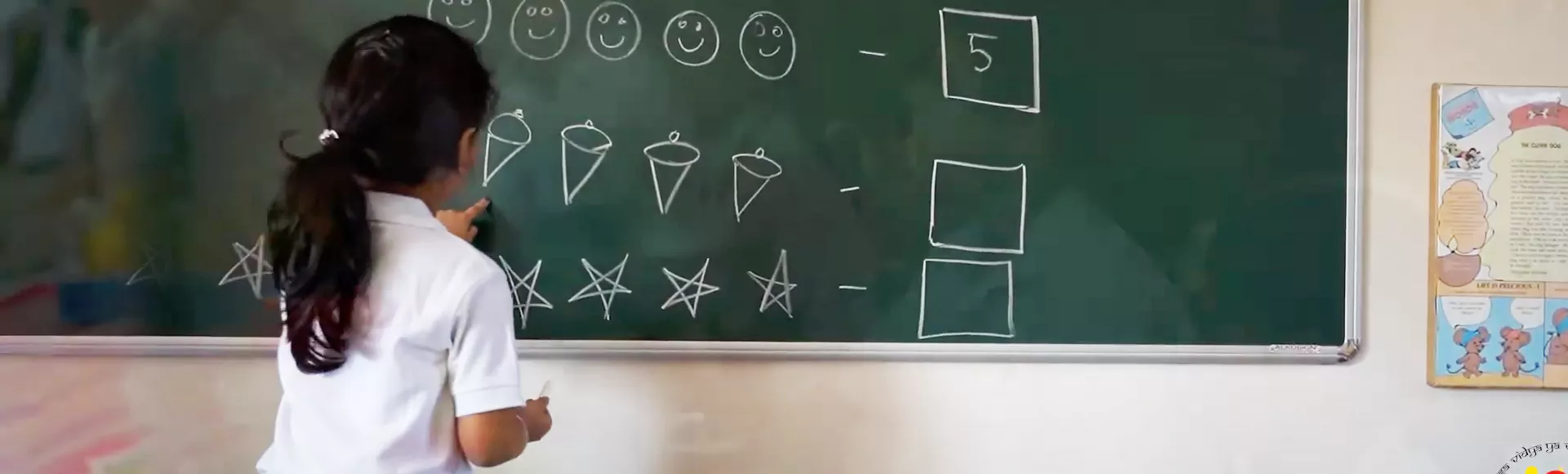
Vidyanjali Academy, hands-on learning is the lesson itself. Children explore
concepts through specially designed materials, golden beads for math, sandpaper
letters for phonics, and knobbed cylinders for sensory refinement. They touch,
move, and manipulate their way into understanding.
This
approach is about helping them construct knowledge physically. Each activity is
intentional, precise, and rooted in a learning outcome.
The Philosophy Behind “Learning by Doing”
Montessori’s
belief in hands-on learning stems from a deeper commitment: educating the whole
child, not just academically, but emotionally, physically, and socially.
Movement, choice, and tactile experiences are built into every part of the day,
helping children connect thought with action.
Instead
of memorising facts, they discover principles. Instead of being told, they
explore. This method respects their developmental readiness and gives them the
tools to build their understanding from the ground up.
Why It Works: Core Montessori Principles That Support It
Hands-on
learning isn’t just a stylistic choice; it’s grounded in the core developmental
principles that guide Montessori education:
●
Planes of Development: Especially during
the first plane (0–6 years), children learn primarily through physical
interaction with their environment. They’re not yet abstract thinkers; they
need to see, touch, and try.
●
The Absorbent Mind: Maria Montessori
observed that children in early childhood absorb knowledge effortlessly from
their surroundings. Tactile, sensory-rich experiences give this absorption form
and depth.
●
Sensitive Periods: These are windows of
time when a child is especially drawn to specific types of learning, like
language, movement, or order. Montessori environments are designed to match
these periods with materials that allow children to act on their natural urges
through physical exploration.
How Montessori Classrooms Support Hands-On Learning
Montessori
classrooms aren’t just learning spaces; they’re carefully designed environments
that invite exploration, independence, and active engagement. Every material,
layout choice, and interaction is meant to support the way children naturally
learn: through doing.
The Prepared Environment: Designed for Discovery
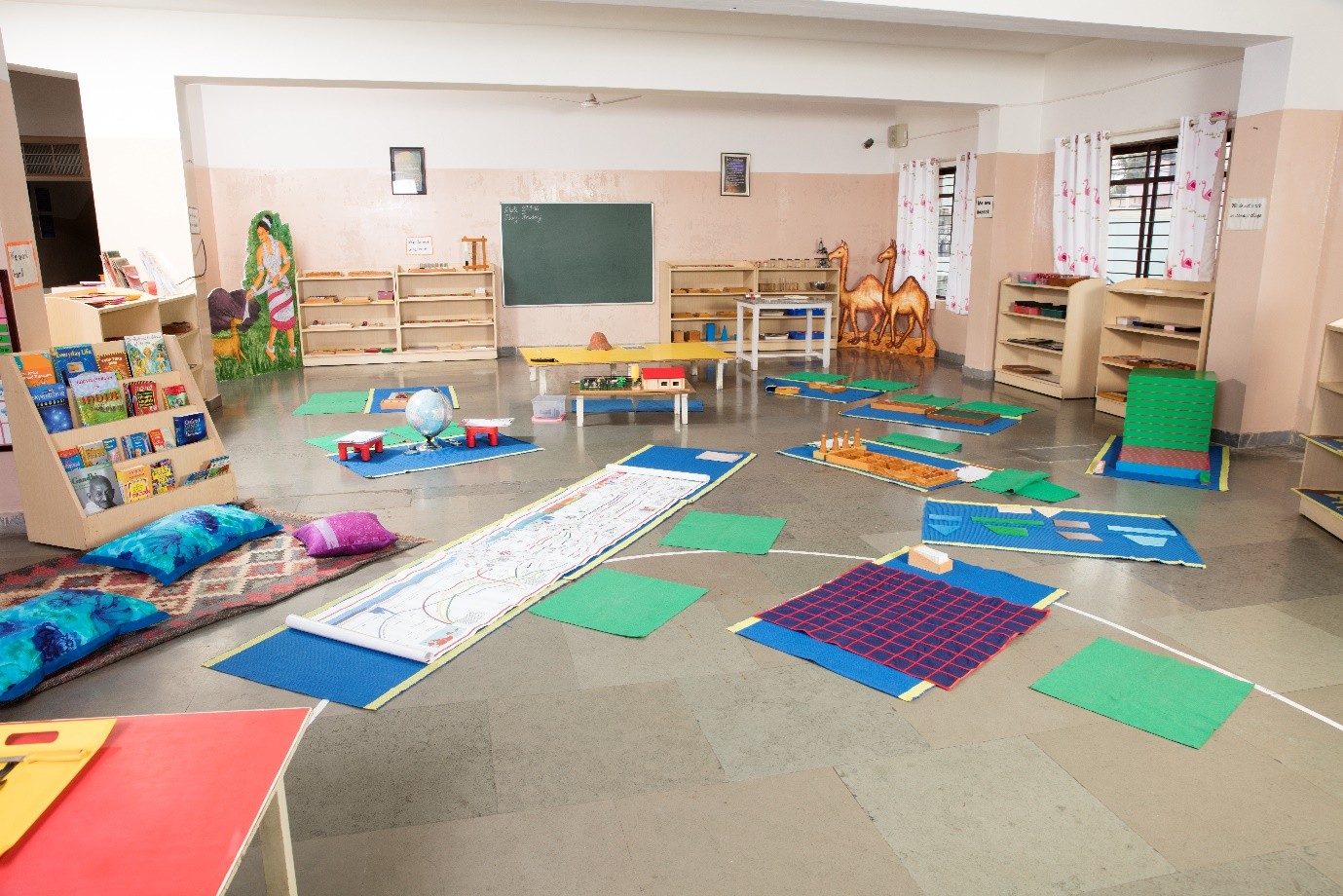
At the
core of every Montessori classroom is a prepared
environment. This means everything is arranged with purpose, from open
floor plans that allow freedom of movement to child-height shelves that empower
choice. Materials are placed intentionally, so children can access, use, and
return them without adult assistance.
Furniture
is sized for children. Light, air, and calm tones create a sense of order. Each
space encourages concentration and independence while eliminating distractions.
This physical setup builds trust in the child’s ability to navigate their world
and fosters self-discipline through routine and choice.
The Role of Montessori Materials
Montessori
materials are not toys. They’re hands-on learning tools designed with
intention. Most are made from natural materials, wood, metal, and fabric,
offering rich sensorial experiences. They are self-correcting, meaning children
can see and fix their own mistakes without adult feedback. This deepens
learning and builds confidence.
Materials fall into five core categories:
●
Practical Life (e.g., pouring, sweeping,
food prep, sewing): Builds fine motor skills, order, and independence.
●
Sensorial (e.g., Pink Tower, Knobbed
Cylinders): Refines senses and prepares the mind for math and language.
●
Language (e.g., Sandpaper Letters):
Introduces phonetics through touch and repetition.
●
Mathematics (e.g., Bead Chains): Teaches
quantity, place value, and operations in a visual, tactile way.
●
Cultural (e.g., puzzle maps, landform
trays): Introduces geography, science, and global awareness.
Mixed-Age Classrooms and Peer Learning
Montessori
classrooms typically group children in three-year age bands (e.g., 3–6, 6–9).
This structure allows younger children to learn by watching older peers and
gives older students a chance to reinforce their knowledge by helping others.
Hands-on demonstrations become part of the daily routine, whether it’s a
five-year-old showing a three-year-old how to polish wood, or a nine-year-old
guiding a classmate through long division with bead chains.
This
natural peer modelling fosters social learning, patience, and leadership,
without the competition often seen in same-age classrooms.
Why Practical Life Activities Matter
Practical
life tasks are some of the first lessons introduced in a Montessori classroom,
and for good reason. Pouring water, preparing food, buttoning a shirt, or
sewing with a needle may seem simple, but they lay the foundation for
everything else. These tasks sharpen motor control, instil a sense of order,
and build sustained focus.
Because
they mirror real-life routines at home, practical life activities help bridge
the school and home environments. Over time, they support the development of
executive functioning, such as planning, sequencing, and problem-solving, which
are essential for academic success.
How Montessori Teachers Shape Learning Through Hands-On Experiences
In a
Montessori classroom, learning doesn’t come from lectures; it comes from doing.
But that doesn’t mean children are left to figure things out on their own. The
teacher plays a central but subtle role, creating the space and structure for
meaningful discovery.
Teachers as Observers, Not Instructors
Montessori
teachers are not the centre of attention; they’re trained observers. Their role
is to study how each child engages with their environment quietly, then
introduce materials at just the right moment. This observation-driven approach
ensures every child moves forward based on readiness, not age or grade.
Instead
of giving direct lessons to the entire group, teachers give short, focused
demonstrations to individuals or small clusters, allowing the rest of the class
to continue working independently. This keeps the classroom calm, purposeful,
and deeply personalised.
Creating Space for Autonomy and Responsibility
A core
part of the teacher’s job is preparing the physical and emotional environment
for exploration. Materials are arranged logically and made accessible so that
children can choose work independently. Routines are consistent, expectations
are clear, and freedom is balanced with responsibility. If a child chooses a
task, they are expected to complete it with care before moving on, instilling
both discipline and ownership.
This
autonomy isn’t chaotic, it’s deliberate. Montessori teachers continuously model
respectful behaviour, peaceful conflict resolution, and practical life skills,
helping children internalise these values over time.
How Subjects Are Taught with Hands-On Tools
Montessori
doesn’t rely on textbooks or worksheets to teach core subjects. Instead, it
uses tactile materials to help children understand concepts in concrete terms
before moving to the abstract.
●
Math: Children begin with number rods to
physically grasp quantity and length. Golden beads introduce place value
through real manipulation. Bead chains help them understand patterns, skip
counting, and even squaring and cubing.
●
Language: Sandpaper letters let children
trace letter shapes while connecting them to sounds. The movable alphabet lets
them build words phonetically, long before they learn to write on paper,
bridging spoken and written language naturally.
●
Science & Culture: Materials like
puzzle maps, botany cabinets, and land & water form trays turn geography
and biology into hands-on learning. These subjects aren’t treated as add-ons;
they’re integrated into daily work to encourage observation, curiosity, and
respect for the world.
Every
Montessori material is designed with a built-in progression, from hands-on to
symbolic to abstract understanding. Children don’t jump to memorisation; they
build understanding layer by layer. This approach doesn’t just teach facts, it
builds real comprehension.
What Are the Benefits of Hands-On Learning in Montessori Education?
Montessori
education is rooted in the idea that children learn best by doing. Rather than
memorising abstract information, students engage with carefully designed
materials that let them explore, test, and understand through direct
experience. This method doesn’t just feel more natural, it produces deeper,
longer-lasting learning outcomes.
Why Hands-On Learning Works
When
children interact with physical materials, they’re not just passively absorbing
information; they’re actively constructing knowledge. This leads to better engagement, higher retention, and stronger cognitive
development. For example, using number rods or bead chains allows students
to see and touch mathematical relationships, which strengthens their conceptual
understanding far more than memorising equations.
Beyond
academics, this approach builds essential life skills. As students navigate
tasks independently, they develop problem-solving
ability, self-discipline, and intrinsic motivation, all while working
at their own pace. They make mistakes, self-correct, and learn through trial
and discovery, not pressure or external reward.
Supporting Different Learning Styles and Emotions
Montessori’s
tactile, visual, and interactive format supports a range of learning styles,
particularly kinesthetic and visual
learners who often struggle in conventional classrooms. Materials are
designed to isolate specific concepts, allowing children to focus, explore, and
repeat until mastery is achieved.
But it’s
not just about how they learn, it’s also about how they feel while learning. Real-world tasks, peer collaboration,
and respectful freedom cultivate emotional
intelligence, patience, and empathy. These “soft skills” are embedded in
the learning process, not treated as separate add-ons.
Montessori vs. Traditional: A Hands-On Comparison
The
contrast between Montessori and traditional education is most evident in how
learning happens:
●
Montessori classrooms are child-driven,
hands-on, and sensorial. Learning materials are designed with built-in
feedback, allowing children to spot and correct their own mistakes. Mastery is
the goal, and students are encouraged to work until they fully understand a
concept.
●
Traditional classrooms tend to be
teacher-led and focused on instruction through worksheets, lectures, and tests.
Feedback often comes later, through grading, and the emphasis is typically on
performance rather than depth of understanding.
What Are the Challenges of Implementing Hands-On Learning in Montessori?
While the
Montessori approach is widely respected for its hands-on, child-led
methodology, implementing it with fidelity poses real-world challenges,
especially when scaled beyond private institutions.
1. High Cost of Materials and Setup
Montessori classrooms depend on specific,
purpose-built learning materials, each carefully designed to isolate a concept
and encourage independent exploration. These aren’t off-the-shelf products;
they must be precise in size, texture, and progression. As a result, outfitting
a complete classroom requires a significant financial investment. This cost
often makes it harder for public schools or under-resourced institutions to
adopt the method fully.
2. Demands on Teacher Training and Skill
Montessori teaching isn’t improvisational; it
requires educators to undergo specialised certification programs that are both
time-intensive and philosophically rigorous. Teachers must learn how to guide
without interrupting, observe without controlling, and step in only when
needed. Without this deep training, even well-meaning educators may misapply
the method, reducing its effectiveness.
3. Misinterpretation of “Freedom Within Limits”
One of the most misunderstood aspects of Montessori
is the idea that children are “free to do whatever they want.” In reality, the
freedom offered is always within a carefully prepared structure. However, when
this balance isn’t maintained, especially by untrained staff, it can lead to
inconsistency in classroom expectations, affecting outcomes and behaviour
management.
4.
Difficulties in Scaling Across Conventional Systems
The Montessori model
doesn’t fit neatly into conventional school systems that emphasise
standardisation, fixed schedules, and outcome-driven assessments. Trying to
replicate it in large public settings often means compromising key principles,
like uninterrupted work periods or mixed-age groups, making true implementation
difficult at scale.