
When
parents first visit Vidyanjali Academy for Learning, they often notice
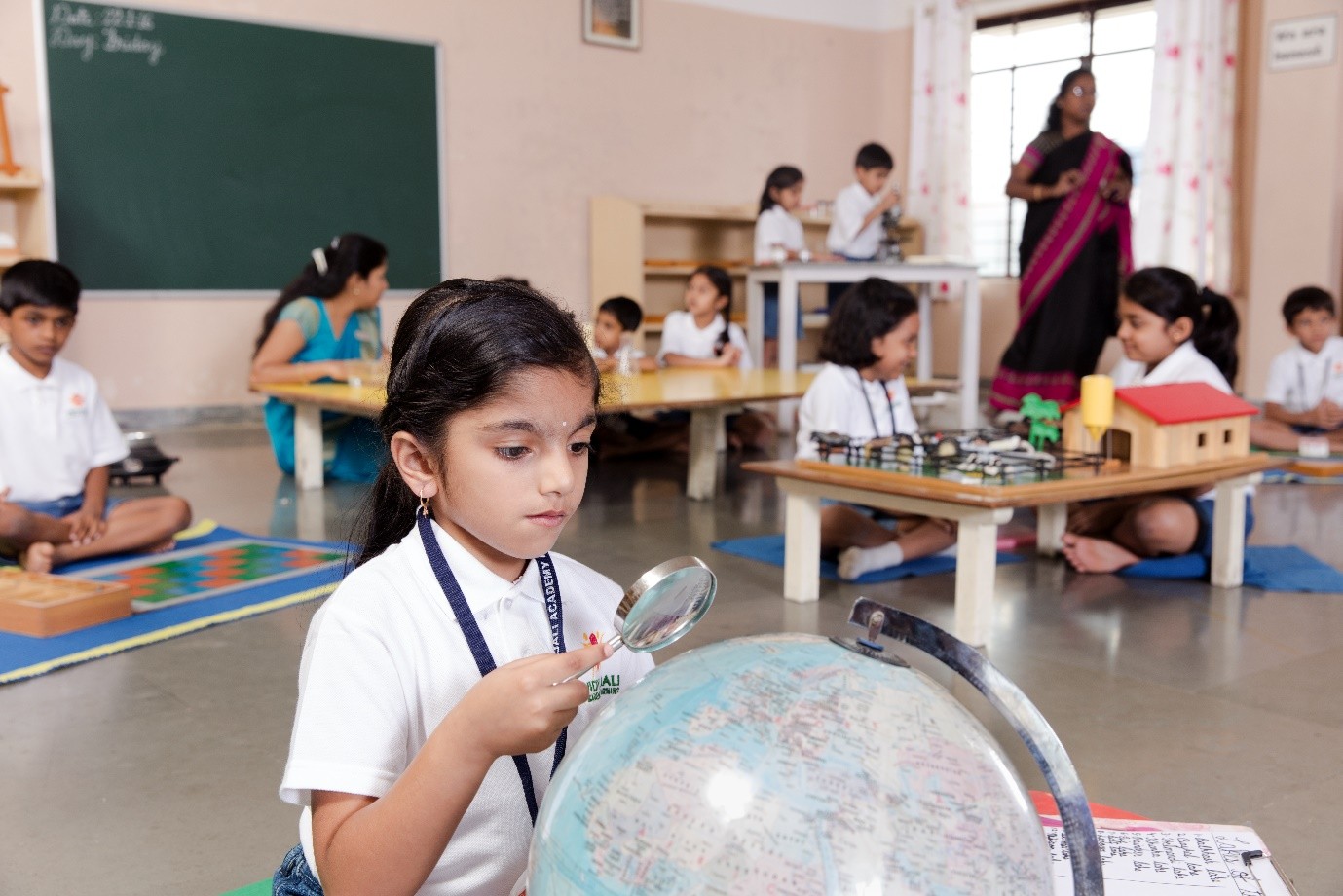
something quietly different about the Montessori environments. Children move
with purpose, choose work independently, help each other without being
prompted, and focus deeply on what they’re doing. There is calm, but also a lot
of thinking and doing.
This is
the heart of Montessori education, an approach that respects each child as
capable, curious, and eager to learn when given the right environment. At
Vidyanjali, Montessori is not a “preschool label”; it is a complete,
research-informed way of working with children, recognised by respected
Montessori bodies and integrated with modern expectations of academic
excellence and life skills.
In this
page, we’ll look at what Montessori education is, the top benefits for your
child, the long-term outcomes shown by research, and how Vidyanjali’s authentic
Montessori program uses this approach from the earliest years all the way into
the primary stage.
What is Montessori education?
Montessori
education began in the early 1900s in Italy with Dr. Maria Montessori, a
physician who opened the first Casa dei Bambini (“Children’s House”) in
Rome in 1907. She observed that when children worked with carefully designed
materials in a prepared environment, they showed an astonishing ability to
concentrate, teach themselves, and take pride in real work.
Since
then, Montessori has grown into a global movement with organisations such as
the Association Montessori Internationale (AMI) preserving and developing her
pedagogy worldwide.
In a
Montessori classroom, you will typically see:
●
Mixed-age groups (for example, 2.5 - 6 years or 6 to 9 or 9 to 12 years),
where younger children learn by watching older ones, and older children deepen
their understanding by helping younger peers.
●
Hands-on, self-correcting
materials that help children understand concepts in
language, maths, sensorial exploration, culture and practical life.
●
Self-directed activity within clear ground rules – children choose work, repeat it, and
return it independently, while adults guide rather than constantly instruct.
At
Vidyanjali Academy for Learning, this philosophy is not theoretical. The
school:
●
Offers an authentic Montessori
programme from around 2.5 years, with a dedicated Montessori environment for
early childhood.
●
Vidyanjali offers Montessori through
the Primary stage (3 to 6 years) to Lower Elementary (6 to 9 years),
with a smooth transition into CBSE from 4th standard, so that
children move from concrete materials to a strong abstract understanding.
●
Has its - Montessori Primary wing recognised by the Indian Montessori Centre and
the Montessori Lower Elementary acknowledged by the Indian Montessori
Association, signaling adherence to recognised standards.
●
Extends Montessori principles
even into sports and movement, through collaborations such as Montessori
Sports, which emphasise autonomy, concentration, purposeful movement and
intrinsic motivation over pure competition.
So, when
we talk about the benefits of Montessori at Vidyanjali, we are talking about a deep,
consistent implementation, not just a name on the board.
What are the top benefits of Montessori education?
One of
the first changes parents notice in Montessori children is growing
independence. From choosing their activities and carrying their own materials
to looking after their environment, children are trusted with meaningful
responsibilities very early.
In
Montessori, this is often described as “freedom within limits” – children are
free to choose work, but within a well-prepared environment and clear community
rules. This balance helps them:
●
Take ownership of their choices
●
Complete tasks without constant
adult prompting
●
Learn to manage time and effort
Over
time, this nurtures intrinsic motivation; children work because they are
interested and proud of their progress, not because someone is watching or
promising a reward.
Social and emotional growth, and the ability to focus
Montessori
classrooms are social environments. Because children work in mixed-age
groups, they naturally help each other, wait their turn, negotiate space and
solve small conflicts under the gentle guidance of adults. Research on
Montessori has consistently noted advantages in social understanding and
emotional development compared to conventional settings.
Key
social-emotional benefits include:
●
Peer learning: Younger children look up to older ones; older children develop
empathy and leadership by assisting younger peers.
●
Grace and courtesy lessons: Many Montessori environments intentionally practice polite
language, turn-taking, and respectful ways of handling disagreements, build the
habit of sustained attention, a core skill for later academic life and
emotional stability.
Personalised learning and critical thinking
No two
children in a Montessori class are doing the same thing at the same moment –
and that is intentional. Instead of
moving a whole class through one textbook page at a time, Montessori teachers observe
each child, understand their readiness, and then connect them with the
right material or lesson.
This
personalised approach supports children who:
●
Move quickly in one area (for
example, reading) but need more time in another (for example, number work)
●
Learn best by touching and
doing, rather than by listening
●
Need a challenge to stay
engaged
The
materials themselves are designed for self-correction; if a child misplaces a
piece, the work “looks wrong,” prompting them to think again instead of waiting
for the teacher’s red pen. This builds critical thinking and problem-solving
because children learn to:
●
Check their own work
●
Analyse what went wrong
●
Adjust their strategy
In Vidyanjali, this culture of thinking is carried forward into the
elementary years, where the Montessori Elementary program (ages 6 to 9)
is designed around the “second plane of development” – a stage where children
begin to ask bigger “why” and “how” questions about the world.
Executive functioning and real-life readiness
Executive
functions – planning, working memory, flexible thinking, and self-control are
some of the best predictors of long-term success in school and life. Multiple
studies have found that Montessori students often show stronger executive
function than peers in traditional classrooms.
Montessori
supports these skills through:
●
Routines and sequencing: Children learn to plan their work cycle, choose activities in
order, and complete them fully.
●
Delayed gratification: Long, multi-step activities (for example, preparing a snack,
polishing, or completing a maths sequence) teach children to stay with a
process and enjoy the outcome after sustained effort.
●
Responsibility for
environment: Tidying, organising shelves, and
caring for materials builds accountability and memory for detail.
Supporting key developmental milestones
Montessori
is structured around developmental planes, broad age ranges during which
children have specific needs and sensitivities. Materials and activities are
designed to support:
●
Sensorial development: refining sight, touch, hearing, taste and smell to build a strong
foundation for maths, science and language.
●
Language acquisition: moving from vocabulary building to written expression and fluent
reading through purposeful, phonetic and tactile work.
●
Motor skills: strengthening both gross and fine motor coordination through;
movement, Exercises of Practical life tasks and precise hand work.
●
Cognitive and emotional
growth: helping children move from concrete
experiences to abstract ideas, while also building self-confidence and social
understanding.
Montessori and traditional education: key differences
Montessori
and conventional classrooms share the goal of helping children learn - but they
approach it differently:
●
Role of the teacher: In Montessori, the adult is a guide who observes and
connects children with the right work at the right moment. In traditional
settings, the teacher more often leads the whole class from the front.
●
Curriculum experience: Montessori has a structured sequence but allows children to
progress at their own pace within that framework. Traditional models often move
everyone together according to a fixed timetable.
●
Assessment: Montessori leans heavily on ongoing observation and children’s own
records of work. Conventional systems rely more on marks, grades and frequent
tests.
●
Student autonomy: Montessori classrooms expect children to make choices and manage
their work; traditional classrooms usually direct students’ actions more
closely.
What are the long-term outcomes of Montessori education?
International
research has repeatedly found that Montessori education can have lasting
positive effects:
●
A landmark study by
psychologist Angelinea Lillard
and colleagues found that Montessori preschoolers performed better over time in
academic achievement, social understanding, executive function and enjoyment of
learning, compared to children in conventional settings.
●
A recent national study (2025)
from the University of Virginia reported that children who attended public
Montessori preschool showed stronger reading ability, executive function,
short-term memory and social understanding in kindergarten.
Is Montessori education right for every child?
Montessori
works beautifully for many children, but parents often have questions and
concerns. Common misconceptions include:
●
“Montessori is too free;
there is no structure.”
In reality,
authentic Montessori environments are highly structured, but the structure lies
in the prepared environment, clear rules and consistent routines rather than in
constant verbal control.
●
“It’s only for very
independent or ‘advanced’ children.”
Montessori
is designed precisely to build independence and concentration, even in
children who initially need more guidance.
●
“Any school that uses the
word ‘Montessori’ is the same.”
Unfortunately, the term is sometimes used
loosely. Families should look for authentic training, recognised affiliations
and classrooms that truly reflect Montessori principles not just a name, it
is allowing children to work with materials as their routine, instead of using
them like teaching aids.
What should you know before choosing Montessori education?
Before
you decide, it helps to keep three things in mind:
1.
Clarify what you want for
your child.
Are you
looking mainly at marks, or also at independence, confidence, social skills and
love of learning? Montessori is particularly strong in nurturing whole-child
development.
2.
Visit and observe.
When you
visit a Montessori environment – at Vidyanjali or elsewhere – notice:
○
Are children focused and calm,
yet engaged?
○
Do they handle materials with
care and move independently?
○
Is the teacher mostly observing
and guiding, rather than constantly directing?
3.
Ask about authenticity and
continuity.
Look for:
○
Recognition by credible
Montessori bodies or associations
○
Teacher training and experience
○ How Montessori continues into the Montessori Primary to Montessori Lower Elementary years and integrates with mainstream curricula like CBSE
Is Montessori better for early childhood development?
Montessori is especially effective in the early years because it aligns closely with how young children naturally learn – through movement, hands-on exploration and repetition. Studies show benefits in language, maths, executive function and social-emotional skills in Montessori preschoolers.Does Montessori education work for every child?
No single approach is perfect for every child, but Montessori is designed to accommodate different paces and styles of learning. A good fit depends on the child’s needs, the school’s authenticity and how well families and teachers partner together.What age is best to start Montessori?
Actually children should begin around 2.5–3 years, when they are ready for more independence but, still in the first plane of development. Vidyanjali’s Montessori programme also welcomes children at this age, helping them build strong foundations early.Do Montessori students do well in traditional schools later?
Research and experience suggest that Montessori students generally transition well, often showing strong concentration, self-discipline and conceptual understanding. Vidyanjali’s own study at Class 4 level showed clear advantages for students with Montessori backgrounds when they moved into CBSE-focused classrooms.Can Montessori be done at home?
You can certainly use Montessori principles at home - offering child - sized tools, involving children in daily tasks, and encouraging independence. However, a full Montessori environment, like the one at Vidyanjali, includes specialised materials and trained guides that are hard to replicate entirely at home.Are Montessori schools better for gifted children?
Montessori can be excellent for children who need more challenge because they can move ahead in areas of strength without waiting for the class. At the same time, the method supports children who need more time in certain areas. The key is careful observation and responsive guidance.Is Montessori worth the cost?
For many families, the value lies in the combination of academic strength, independence, social skills and emotional well-being that Montessori supports. When implemented deeply and authentically, as at Vidyanjali, it can be a long-term investment in how a child thinks, feels and relates to learning itself.How do I choose a good Montessori school?
To choose a good Montessori school, look for:●
Authentic recognition or
association with reputable Montessori bodies
●
Prepared environments with real
Montessori materials
●
Calm, purposeful classrooms
where children are genuinely engaged with hands on experience activities based
on the Montessori Method of education.
Trained teachers who respect children’s pace and choices and who encourage children to do it themselves and assist if, it is the need of the children.