
In primary school, assessment isn’t meant to feel like a verdict.
It’s supposed to help teachers understand how a child is learning step by step
so they can support them better. With NEP 2020 encouraging a more holistic
approach, many classrooms are moving away from judging children only through
marks and tests, and toward tracking real progress, curiosity, and emotional
readiness.
That’s the lens Vidyanjali Academy uses, too. Teachers observe
children during Montessori-based work, build portfolios over time, and discuss
development through structured Parent Engagement Conferences. By the end of
this blog, parents will know what “assessment” really looks like in today’s
primary grades and how to interpret their child’s progress beyond scores.
What’s the Difference Between Assessment and Evaluation?
While often used interchangeably, assessment and evaluation serve
different purposes in a primary school setting.
●
Assessment is ongoing and diagnostic. It helps teachers understand how a child
is learning in real time. This includes activities such as observation notes,
reading journals, class discussions, and skill-based worksheets. These are not
about grades; they focus on feedback and improvement.
●
Evaluation, on the other hand, is a final judgement. It usually takes place at
the end of a term or unit and focuses on performance. Examples include report
card grades, end-of-unit tests, or project presentations that summarise what
has been learned.
For instance, a teacher may assess a student’s reading fluency week
by week using informal checklists. At the end of the term, the student may be
evaluated through a reading comprehension test or an oral presentation.
Why Are Assessment and Evaluation Important in Primary Education?
Used together, both processes ensure that learning remains
meaningful and student-focused. Here is how they help:
●
Monitor academic progress over
time instead of relying on one-time scores
●
Identify learning gaps early so
that support can be provided
●
Encourage motivation and
confidence by showing children how they have improved
●
Inform teachers and parents
with specific, actionable insights
Vidyanjali Academy uses both types of teaching to help each child
grow, not just in school, but also in terms of curiosity, mental health, and
readiness for life outside of school.
What Are the Types of Assessment Used in Primary Schools?
At Vidyanjali Academy, assessment isn’t treated as a once-in-a-while
test. It’s built into everyday learning, so teachers can see what a child
understands, where they’re gaining confidence, and where they may need a
different approach. That’s why the Academy uses a mix of methods, instead of
relying on a single score, to get a fuller and fairer view of each student’s
development.
Formative Assessment
This happens regularly and is woven into regular classroom life.
Teachers observe students as they work, ask reflective questions, provide
instant feedback, and adapt lessons based on real-time understanding. Tools
include:
●
Informal quizzes
●
Peer discussions
●
Classwork observations
●
Student self-evaluations
These assessments guide instruction, support learning, and help
teachers respond to individual needs.
Summative Assessment
Summative tools are used at the end of a term or unit to evaluate
what a student has retained. These include:
●
End-of-term tests
●
Formative assessment
●
Report cards with qualitative
and quantitative feedback
They provide a snapshot of performance and are shared with parents
for clarity and transparency.
Diagnostic Assessment
These are used to spot learning gaps before teaching starts. They’re
especially helpful when students are moving into a new grade or when their
progress has been uneven. The goal is to catch concerns early so support can be
planned from day one.
Criterion-Referenced and Norm-Referenced Assessment
In criterion-referenced assessments, students are evaluated against
fixed learning goals. For example, whether they can apply multiplication in
real-life scenarios. In norm-referenced assessments, a student’s standing is
understood in relation to broader peer groups. For example, how their
multiplication fluency compares to other Class 3 students across the school,
district, or even a larger standardized testing sample. Both approaches help
ensure that growth is tracked accurately.
We also align our assessments with Bloom’s Taxonomy, covering all
levels, from remembering and understanding to applying, analyzing, and
creating. This ensures students are not just memorizing content, but engaging
with it more deeply.
How Is Student Evaluation Handled in Primary Years at Vidyanjali Academy?
At Vidyanjali Academy, assessment is treated as part of the learning
process, not a pause button. Teachers track progress continuously through
everyday classroom observation, and they also use Parent Engagement Conferences
to sit down with families and share what they’re seeing over time. The goal is
simple: understand how each child is growing across cognitive (thinking),
affective (emotions and attitude), and psychomotor (movement and coordination)
development.
Because children don’t all show learning the same way on the same
day, evaluation is not limited to written tests. It is intentionally varied and
child-centred. Students are assessed through:
●
Storytelling, art, music,
drama, and role play
●
Group projects, Discipline and
physical activities
●
Regular class discussions and
observation-based insights
This allows us to see each child as a whole learner, not just a
performer of written tasks.
What Makes CCE Effective?
CCE encourages consistent growth by
incorporating small, low-pressure assessments into daily learning. It helps
teachers:
●
Identify learning gaps early
●
Adjust teaching methods in real
time
●
Support emotional and social
development
●
Encourage effort, curiosity,
and reflection, not just right answers
At Vidyanjali, this approach is seamlessly
integrated into our lesson design. For example, a geography project might
assess research, collaboration, creativity, and presentation within a single
activity.
What Evaluation Tools Are Used?
Our teachers use a variety of age-appropriate methods:
●
Rubrics and checklists to
assess specific skills
●
Anecdotal records to capture
learning moments that tests cannot measure
●
Portfolios and performance
tasks that document long-term growth
●
Peer and self-assessment to
build awareness and reflection
At Vidyanjali Academy, assessment isn’t saved for the end of a unit.
Teachers track learning in real time, during classwork, conversations,
activities, and everyday practice, so they can spot what a child truly
understands and what still feels shaky. That’s also why the Academy doesn’t
reduce progress to one score. It uses more than one way to check learning, so
each child is evaluated with more context and less guesswork.
How Often Are Assessments Conducted?
We avoid high-stakes testing. Instead, we use frequent, low-stakes
checks throughout the term. This provides a steady flow of insights without
disrupting motivation or increasing anxiety. The goal is to make assessment
feel like part of learning, not a break from it.
How Is Assessment Data Used?
Assessment is not the end of the process; it is a tool for growth.
Teachers at Vidyanjali use the results to:
●
Give meaningful feedback to
students
●
Create personalised learning
plans
●
Flag areas where early
intervention is needed
●
Collaborate with parents to
support children more effectively
We focus on feedback loops, where learners are encouraged to revisit
work, reflect, and improve.
What Role Do Parents Play?
We see parents as partners in the assessment journey. Through:
● Regular parent–teacher meetings
● Clear report cards with narrative feedback
● Guidance on how to support learning at home
How Are Holistic Skills Like Creativity and Emotional Intelligence Assessed?
At Vidyanjali Academy, holistic development is not treated as
“extra.” We pay attention to how a child grows emotionally, socially,
creatively, and physically, because these areas shape confidence,
relationships, and long-term learning.
Life Skills, Values, Teamwork, and Empathy
A lot of learning shows up in the little moments. Teachers pay
attention to how children manage everyday moments, sharing materials, listening
to others, waiting for their turn, working through small disagreements, helping
a classmate, or staying steady when something feels hard. Those small choices
tell a lot about skills that matter in and out of school: empathy,
self-control, responsibility, respect, and how well they work with others.
Rather than reducing this to one “score,” educators look for patterns over time
using classroom notes, short reflections with the child, and regular feedback.
Creative Arts and Physical Education Assessment
In creative arts and physical education, assessment isn’t about
who’s “best.” It’s about how a child shows up, stays engaged, and improves over
time. Teachers look for the small, real signs that a child is growing: showing
up, joining in, and putting in effort even when something feels new. That might
look like attempting a different brush technique in art, keeping time a little
longer in music, remembering a movement pattern, or building stamina during
sports. The goal is steady progress, better coordination, more confidence,
stronger teamwork, and a “let me try again” attitude without turning it into a
comparison between children.
Co-Curricular Achievements Tracking
We also track co-curricular involvement in a structured way,
including projects, performances, competitions, events, and clubs, so parents
can clearly see where a child is showing interest and how their abilities are
developing. This helps us guide students toward activities that strengthen
confidence, communication, leadership, and consistency.
The Bigger Picture at Vidyanjali Academy
Our goal is simple: to understand the whole child. Academic progress
matters, but so does kindness, resilience, independence, and creativity. When
we assess holistic skills, we’re ensuring your child is growing into a capable
learner and a grounded individual, not just finishing a syllabus.
What Makes Vidyanjali Academy the Best School for Assessment and Evaluation?
At Vidyanjali Academy, assessment is treated as a way to understand
a child, not a way to label them. The focus stays on how children are learning
and growing day to day, not just what they can reproduce on a worksheet.
Assessment isn’t only about what a child knows. It’s also about what they do
with that knowledge. Teachers don’t just look at the final answer. They watch
how a child begins the task, what they try when the work gets difficult, and
whether they can explain why they made a certain choice. Over time, they also
notice small changes like needing fewer prompts, checking their own work, and
handling more steps on their own.
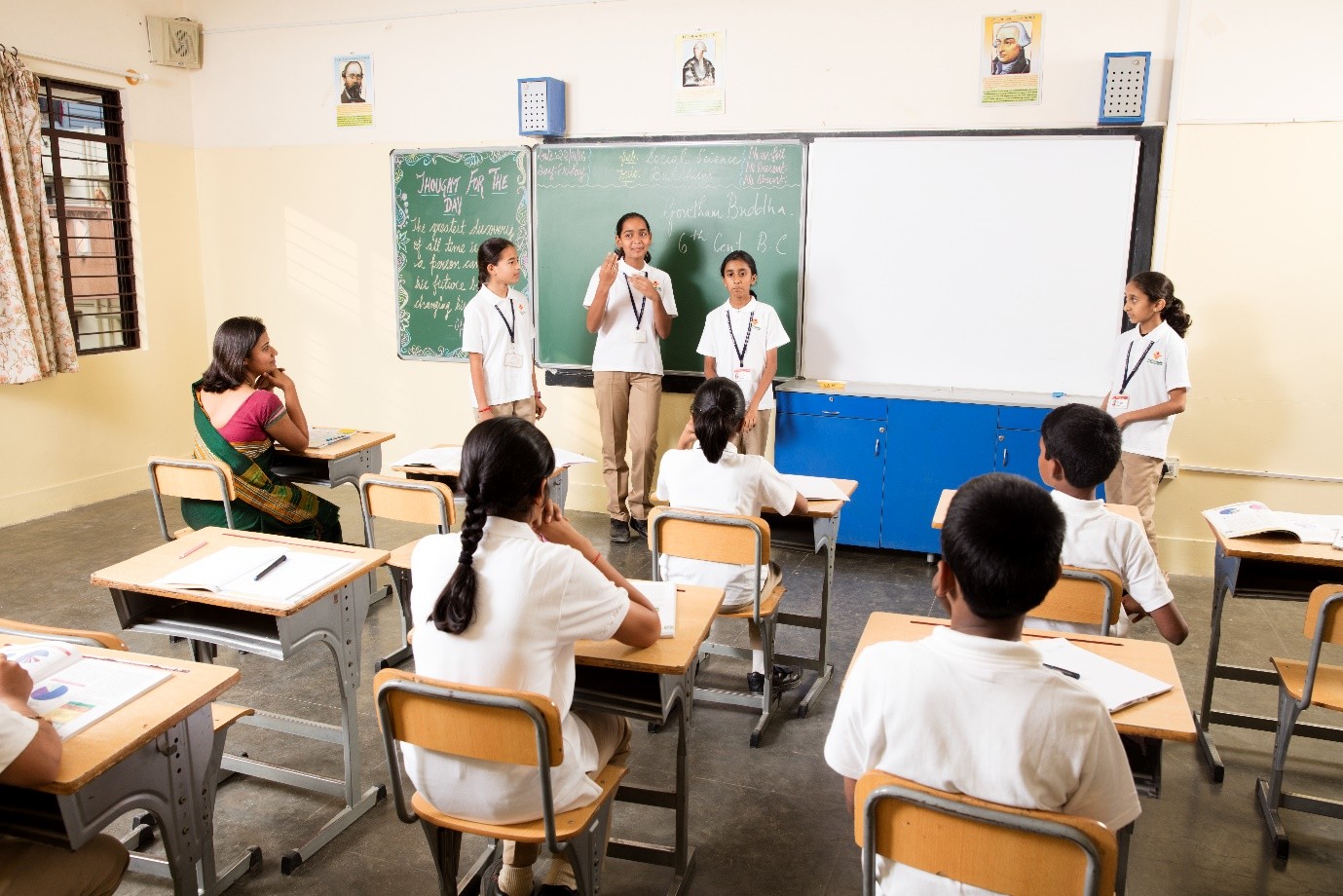
In day-to-day classroom life, assessment can look pretty normal: a
short reflection journal, a small-group activity marked with a clear rubric, a
one-on-one check-in, or observation notes that capture how a child actually
works, not just what they can repeat back. The aim is to keep it meaningful and
personal, so each learner is evaluated in a way that matches how they learn
best.
Families are welcome to explore this approach and see how it plays
out in real classrooms. To learn more about Vidyanjali Academy’s assessment
practices or to begin an enquiry, please visit the website.